
Commercial Kitchen Hood Cleaning in Huntsville, AL
Huntsville Hood Cleaning handles commercial kitchen hood cleaning, grease duct and exhaust fan cleaning, filter service and rooftop grease containment for restaurants and commercial kitchens across Huntsville and Madison County. Typical visits run $300 to $1,800 by kitchen size (2026 national ranges), scheduled off-hours, with a free written quote.
- NFPA 96 Table 12.4 cleaning schedules honored
- Ask for a service report & cleaning sticker at every visit
- Hood, duct, fan, and rooftop: complete system coverage
- Off-hours scheduling to protect your service
Commercial Kitchen Hood Cleaning Services in Huntsville, AL
From the baffle filters at eye level to the exhaust fan on the rooftop, every component of your kitchen exhaust system needs to be cleaned and documented. Quote the whole system, not just the hood.
Most kitchens book the complete system in a single visit so every component lands on the same service report. Each service below also has its own page if you need one part of the system handled on its own.
- Exhaust Fan Cleaning → Fan wheel, housing, and motor compartment degreased. Hinge kit installation included if needed for proper tilt-out access.
- Rooftop Grease Containment → Grease containment systems installed and serviced. Prevents roof damage and fire risk from pooled grease around exhaust fan bases.
- Restaurant Exhaust Fan Repair → Slipping belts, worn bearings, failed motors and hinge kits on the rooftop fan that pulls smoke out of the hood.
- Food Truck Hood Cleaning → Hood, filters, short duct and roof fan on mobile kitchens, cleaned at the commissary with a sticker for the fire inspection.
- Restaurant Kitchen Deep Cleaning → Walls, floors, drains and the space behind and under equipment, booked the same night as the hood cleaning.
- Wood-Fired Oven and Smoker Hood Cleaning → Monthly solid fuel service: creosote, spark arresters, duct and fan above pizza ovens and smokers.
- Kitchen Hood Inspection → Depth gauge readings from filters to fan on the NFPA 96 schedule, before a lease, after a menu change or between cleanings.
How It Works
- 1
Request a free quote
Call, or send the quote form with your kitchen details and location.
- 2
Get a written estimate
The system is assessed and you get the scope and the price in writing.
- 3
Work gets done
Once you approve the written estimate, the cleaning is scheduled and carried out.
What Huntsville Fire & Rescue Looks for When They Inspect Your Kitchen
Get quotes to clean the full Type I grease exhaust system of your Huntsville restaurant or commercial kitchen to NFPA 96: hood and plenum, baffle filters, grease duct, and rooftop fan, finished with a dated certificate and written report for fire inspectors. Most full-service restaurants need it every six months, high-volume kitchens every quarter, and solid-fuel kitchens monthly.
Restaurants, cafeterias, hospitals, hotels, and quick-service kitchens across Madison County, with off-hours scheduling and a firm written quote to ask for before any work starts.
Huntsville Fire & Rescue enforces NFPA 96: Standard for Ventilation Control and Fire Protection of Commercial Cooking Operations. This is the national standard adopted across Alabama that governs your kitchen exhaust system. When an inspector arrives, they check three things: cleaning frequency compliance, a valid service certificate on the hood, and the overall condition of the exhaust system.
The Alabama Department of Public Health (ADPH) separately inspects food establishments under Chapter 420-3-22 of Alabama's food sanitation rules, which incorporates the FDA Food Code standards for ventilation equipment maintenance. A dirty exhaust system is a dual violation: fire code and food safety.
Beyond inspections, your insurance carrier matters. Most commercial property policies covering grease fires require documented, certified cleaning at the frequency mandated by NFPA 96 for your kitchen type. If a fire occurs and your records show overdue cleaning, a claim can be denied.
Leases and franchise agreements add two more layers. Most Huntsville restaurant leases put the exhaust system, rooftop grease damage, and roof membrane condition on the tenant, and national brands typically specify a cleaning frequency, a contractor certification standard, and a record retention period, then audit against it. A complete certificate and written report should be built to satisfy those common requirements.
What NFPA 96 Requires of a Commercial Kitchen
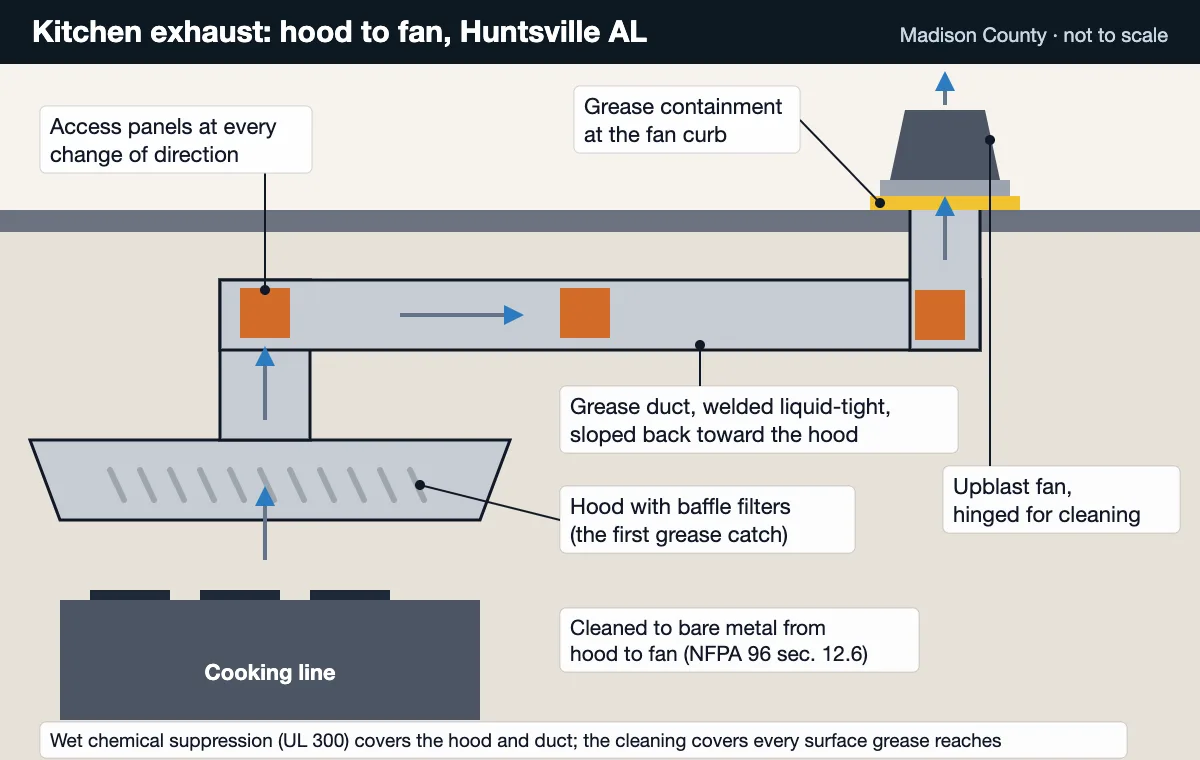
NFPA 96 applies to cooking operations that produce grease-laden vapors, which covers essentially every restaurant, cafeteria, hospital kitchen, hotel banquet kitchen, and food truck in Huntsville. It carries three obligations: the exhaust runs through a listed Type I hood and a welded, liquid-tight grease duct; the appliances are protected by a UL 300 wet chemical suppression system; and the whole system, filter face to fan discharge, is inspected and cleaned on a fixed schedule with the work documented.
The third obligation is the one that produces violations, because it is the only one that decays. A hood installed correctly in 2016 is still installed correctly today. A hood cleaned in 2016 is a fire hazard today.
Type I Hood
Installed over fryers, charbroilers, griddles, ranges, woks, solid-fuel grills, and rotisseries. A listed assembly with baffle filters, a welded liquid-tight grease duct, and a UL 300 wet chemical suppression system. Everything NFPA 96 Chapter 12 says about inspection and cleaning applies here, and it is the hood a Huntsville fire inspector will ask about.
Type II Hood
Installed over dishwashers, steamers, ovens, and warming equipment. It still needs cleaning to stay sanitary and keep airflow correct, but it is not on the Chapter 12 grease schedule and needs no suppression system. A Type II hood does not exempt the Type I hood over your cooking line.
Residential Range Hood
No listing for commercial cooking, no suppression, no welded duct. A food business running commercial equipment under a residential hood has a code problem no cleaning contract can fix, and an honest cleaner will say so rather than sell a service that will not pass inspection.
How Often Does Your Huntsville Restaurant Need Hood Cleaning?
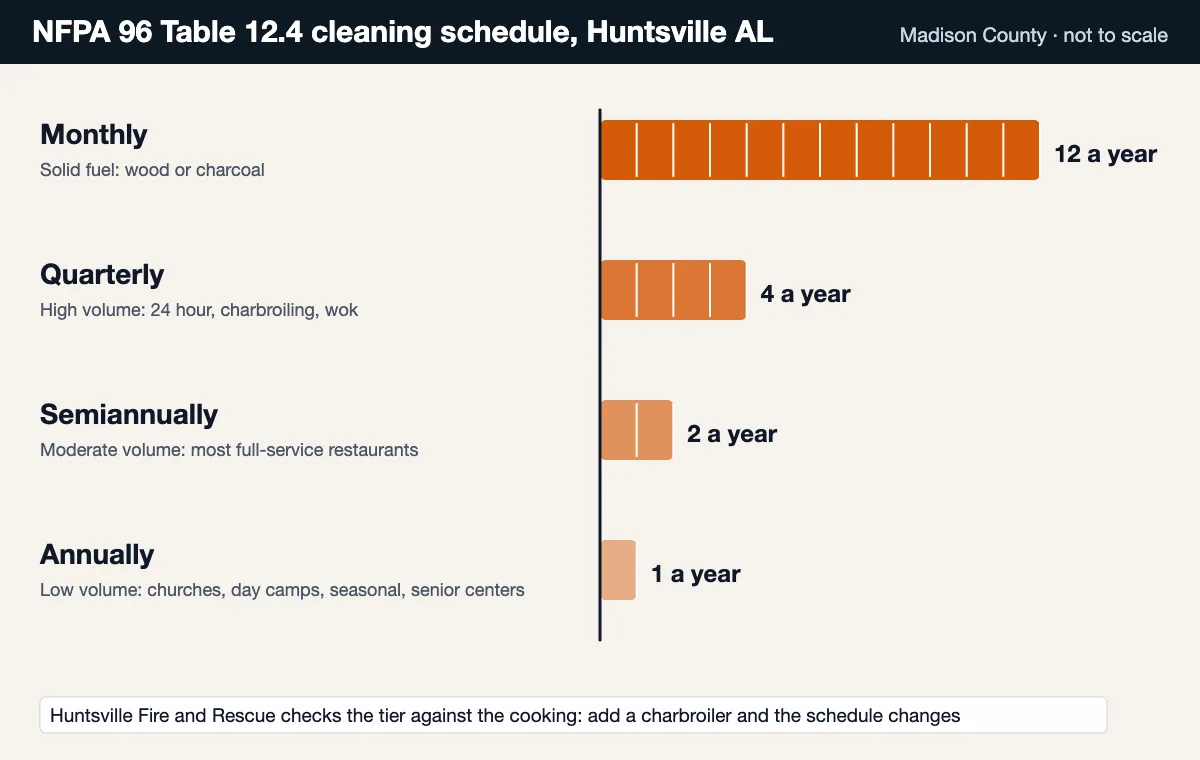
This is the single most searched compliance question restaurant operators in Huntsville ask, and the answer comes directly from NFPA 96 Table 12.4. The schedule is based on your kitchen's cooking volume and fuel type, not a one-size-fits-all calendar.
Note: Table 12.4 sets the inspection frequency. Cleaning is required separately under Section 12.6.1.1 any time a depth gauge reads 0.078 inch on hood, plenum or duct surfaces (0.125 inch inside a fan housing), regardless of how recently the last scheduled service was performed. A kitchen hood inspection is how those readings get taken.
Long hours count. Table 12.4 names 24-hour cooking, along with charbroiling and wok cooking, as high volume, so a kitchen that runs from early morning to late night belongs in the quarterly row or tighter. Wood and charcoal kitchens are monthly; see wood-fired oven and smoker hood cleaning.
Section 12.6.2 adds a proactive duty: maintain the system before surfaces become heavily contaminated. If your menu shifts toward higher-fat items or your hours extend, tighten the interval before the next inspection, not after it. Our NFPA 96 compliance guide covers the standard section by section.
Get a Free QuoteHow a Compliant Hood Cleaning Is Performed
Nine steps, in this order, every visit. Measuring before cleaning produces a defensible record, and working from the fan back toward the hood stops loosened debris from redepositing in a section already finished.
See all nine steps in detail
- 01
Measure grease depth
Readings at the plenum, filter faces, first duct riser, and fan housing are written down before work starts. That starting figure is what turns a cleaning into a defensible compliance record.
- 02
Contain and protect the kitchen
Cooking equipment, prep surfaces, and floors are sealed with plastic sheeting and absorbent matting, and drains are covered so caustic runoff never reaches the grease interceptor.
- 03
Soak and inspect the filters
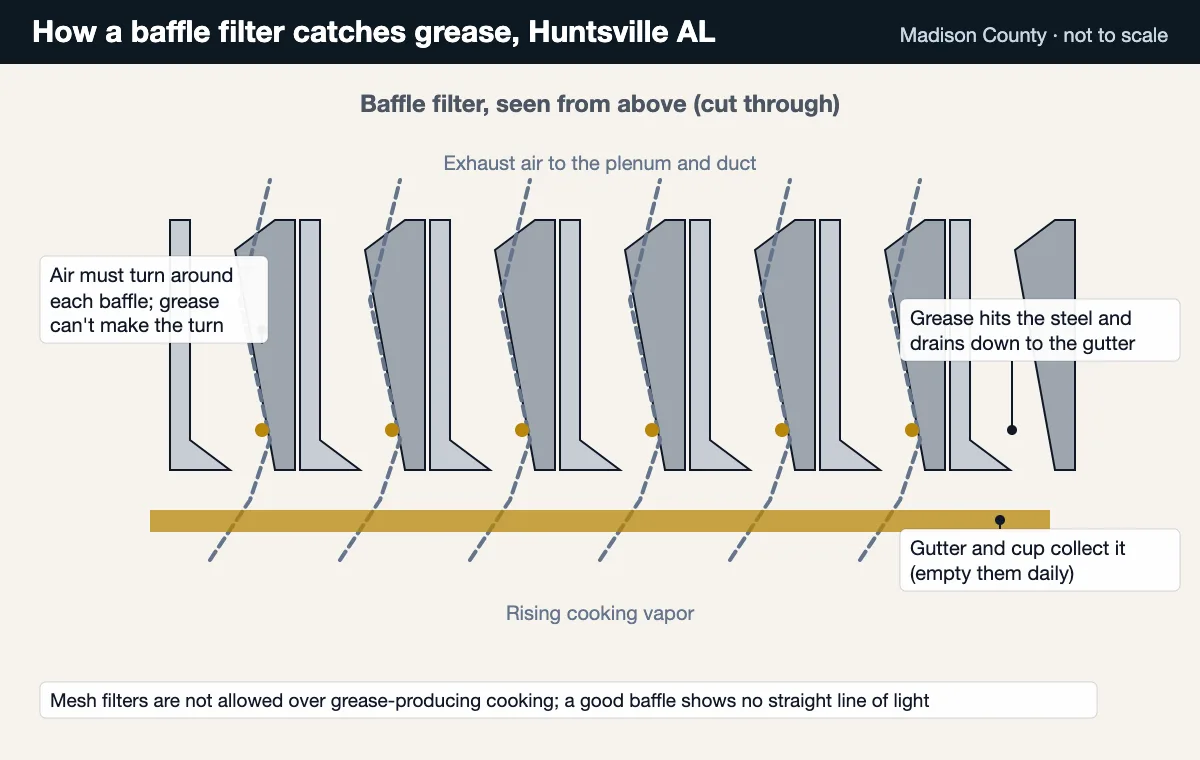
Baffle filters go into a heated caustic bath, then get checked for bent baffles, corroded frames, and blocked drain slots. A filter that no longer channels grease is replaced, not reinstalled.
- 04
Degrease the plenum and canopy
The plenum behind the filter bank holds the heaviest deposits and is the area a low-effort cleaner skips. Proper service takes the plenum walls, grease gutter, and drip cup housings back to bare metal.
- 05
Clean the duct riser and horizontal runs
Rotary brushes, extension rods, and hot high-pressure water, section by section. NFPA 96 requires the entire duct cleaned to bare metal, not just the first few feet.
- 06
Install access panels where needed
Unreachable sections get a listed access panel at the correct spacing. On older Huntsville buildings with long horizontal runs, panels are usually the difference between a partial clean and a compliant one.
- 07
Service the rooftop exhaust fan
The fan is locked out and hinged or lifted off its curb. Wheel, housing, intake cone, and drain are degreased, and belt tension and wheel balance are checked while it is open.
- 08
Clean up the roof and containment
Pooled grease around the curb is removed, the membrane is checked for staining, and containment media is replaced or a containment system is recommended if none exists.
- 09
Re-measure, certify, and report
Grease depth is measured again at the same points. A dated certificate goes on the hood, and the written report lists every component, any area that could not be reached and why, and photos of the finished system.
Scraping, Pressure, Foam, and Steam
No single technique cleans an entire Type I system to bare metal, and a quote built around one method usually skips part of the system. A thorough job combines them:
- Mechanical scraping: Necessary first pass on heavy carbonized or solid-fuel buildup. Almost never sufficient on its own.
- Hot water pressure washing: The workhorse that gets a duct back to bare metal, with disciplined containment so water never reaches ceiling voids.
- Foam degreasing: Strong support on long horizontal runs where water volume must be limited. Weak as a standalone program.
- Steam: A finishing tool for stainless and filters. A contractor selling steam as the whole method is selling a look, not compliance.
Clean Kitchens. Compliant Systems.
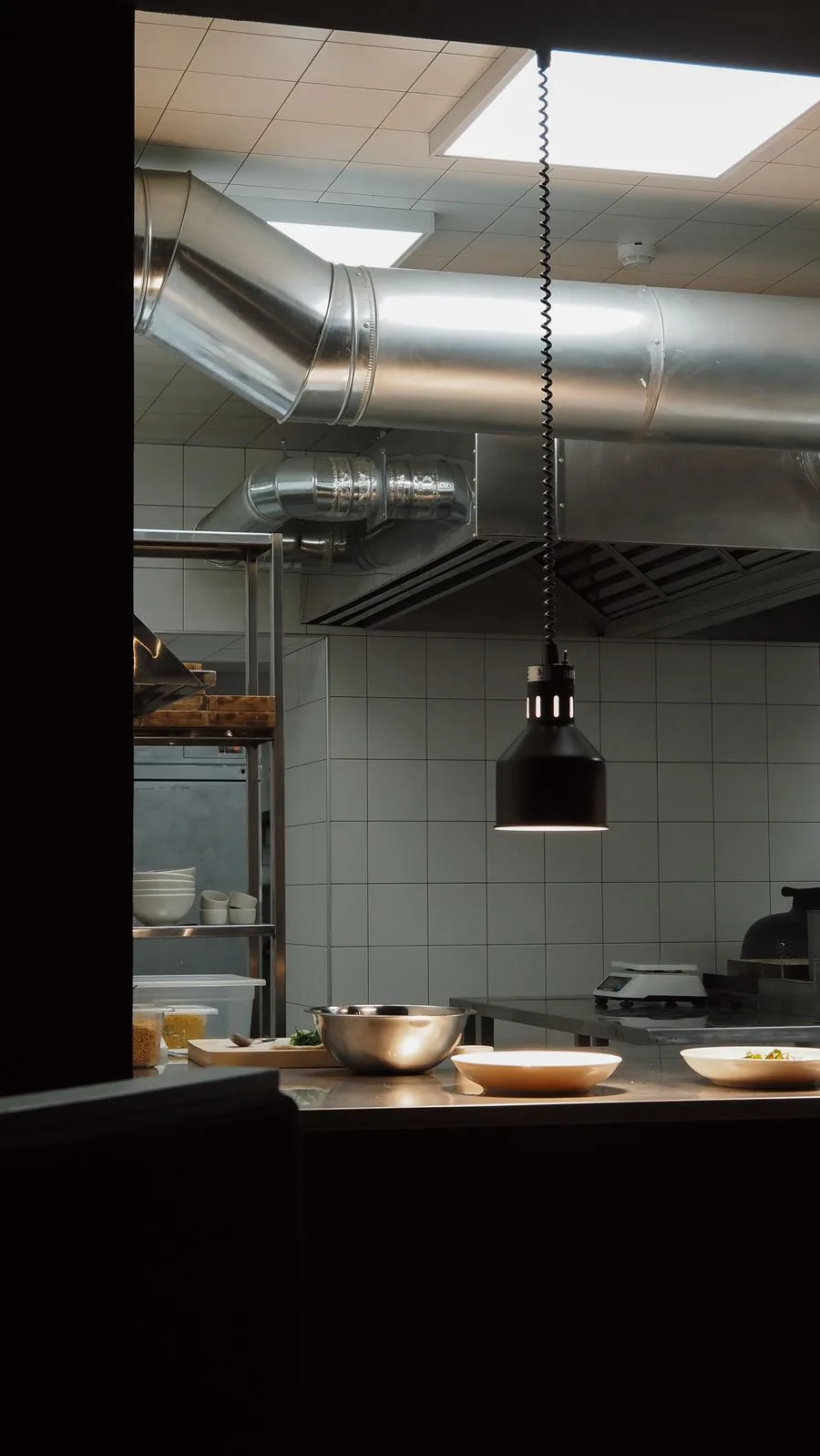
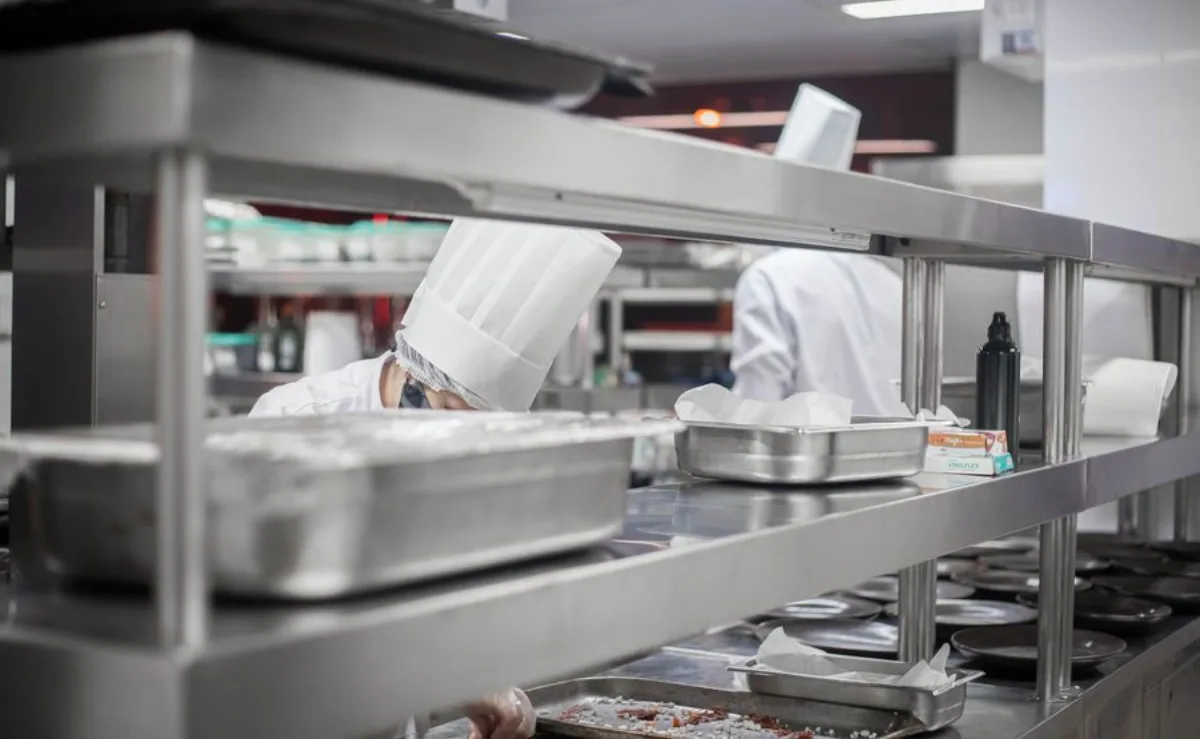
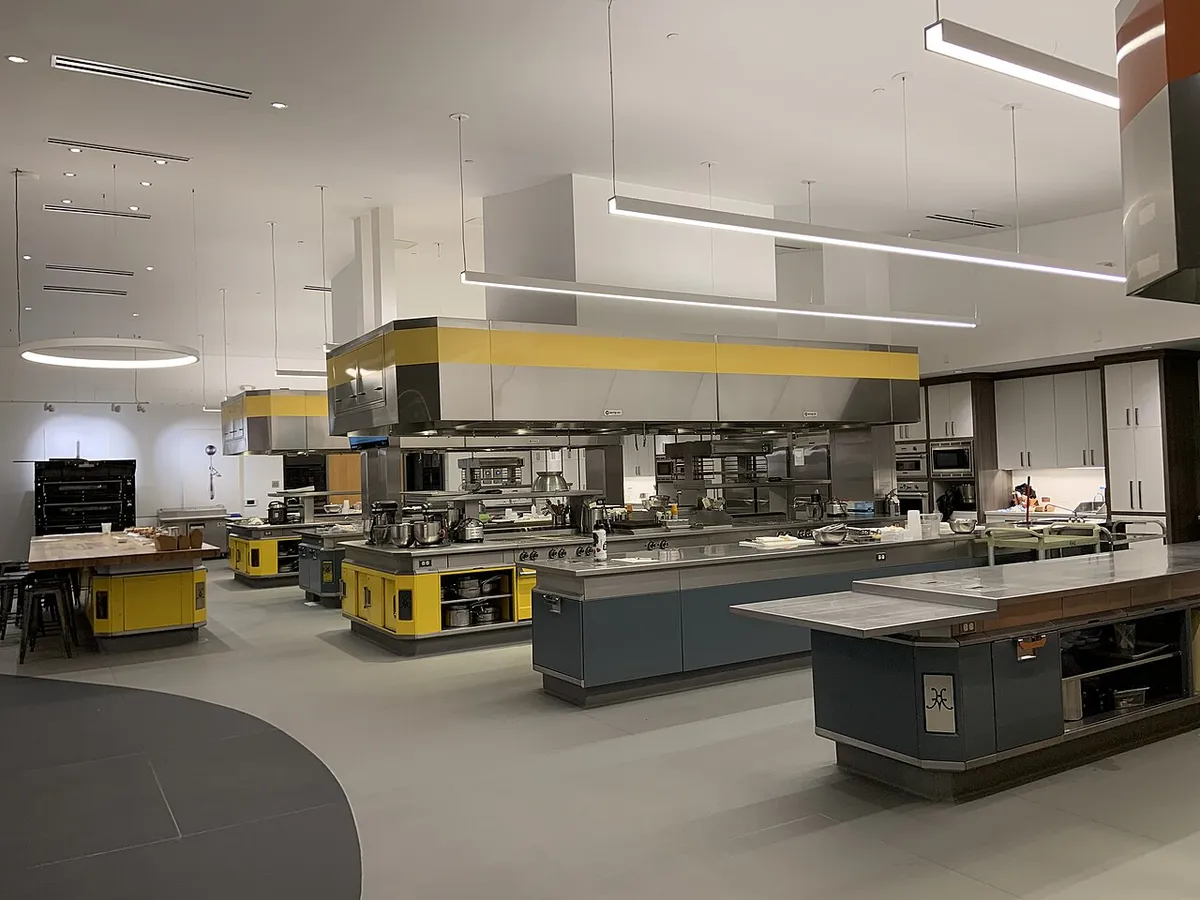
A properly serviced exhaust system means clean stainless, unobstructed ducts, and documentation your fire marshal and insurer will accept.
What Gets Checked in a Huntsville Kitchen Inspection
Kitchen exhaust in Huntsville sits under three authorities. The city building department permits the mechanical installation when a hood, duct, or fan is installed or altered. Huntsville Fire & Rescue enforces the adopted fire code, including NFPA 96, through routine and complaint-driven inspections. The Alabama State Fire Marshal provides the statewide framework behind them.
Installing or relocating a hood, extending a duct, or swapping a rooftop fan for a different size is permitted work, not maintenance. Cutting access panels during a cleaning is maintenance and is not. Our hood cleaning permit guide explains how that intersects with your food service permit.
Older buildings downtown and along the Governors Drive and Memorial Parkway corridors often have long horizontal duct runs to a rear roof penetration with few or no access panels. If your system was cleaned by someone who never opened a panel, the section over your dining room has probably never been touched.
- Current cleaning certificate on the hoodVisible, dated, and showing who did the work and when the next service is due. A certificate in an office binder is not what an inspector wants to find.
- Interval matched to your cooking typeAn annual certificate on a charbroil-heavy kitchen invites a violation on its own.
- Filters correct and correctly seatedListed baffle filters covering the full bank. Mesh filters and gaps between filters both get written up.
- Grease cups not overflowingThe most common visual violation, and the cheapest one to avoid.
- Suppression tag currentThe UL 300 system has its own semi-annual inspection by a licensed fire protection contractor. Inspectors check that tag alongside your cleaning certificate.
- No grease around the rooftop fanGrease pooling on the roof membrane is a fire code finding and a building maintenance bill.
Why Huntsville Restaurant Operators Should Ask for Certified Hood Cleaners
One quick check on any cleaner: the rooftop fan
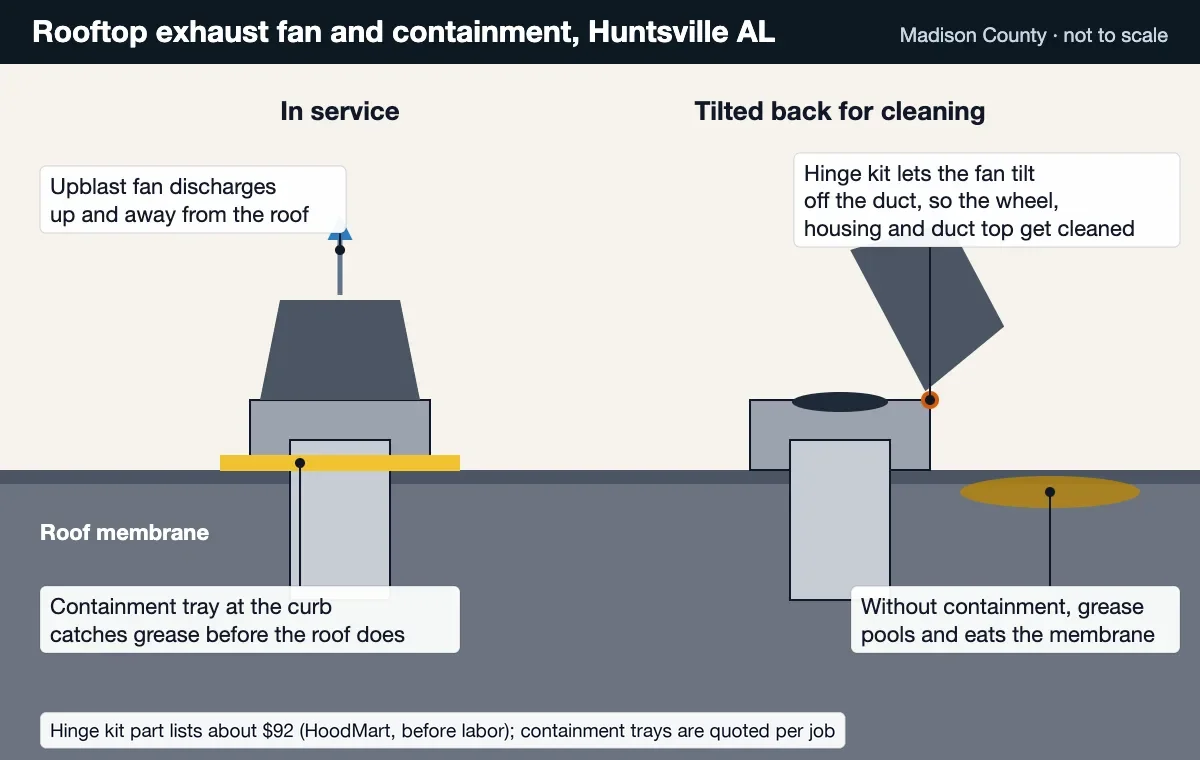
Not all hood cleaning is equal. A certified technician follows the full NFPA 96 process: cleaning from the fan back to the hood, installing access panels where needed, documenting grease levels before and after, and leaving a legally compliant service sticker. An uncertified crew may clean only what's visible and skip the documentation.
CHDCA (Certified Hood and Duct Cleaners Association) certification is based on the NFPA 96 standard and recognized by fire marshals and insurance carriers. Ask any cleaner who quotes your kitchen for the technician's certification number and whether the work follows the protocol Huntsville Fire & Rescue and ADPH inspectors look for.
Ask for a certificate of commercial general liability insurance before work starts. If your landlord, franchise agreement, or insurance policy requires certified cleaning records, confirm the documentation you will receive meets those requirements.
Serving Huntsville and the Surrounding Area
We serve restaurants, cafeterias, hospitals, hotels, and commercial kitchens throughout Madison County and neighboring communities.
Huntsville Hood Cleaning Price Ranges
Diagram: visits a year under Table 12.4
Pricing depends on the number of hoods, duct length, cooking volume, and service history. No Huntsville company publishes prices, so these are the 2026 national ranges from the National Hood Cleaners Association. Ask for a firm quote before any work begins, with filters, access panels, and containment itemized. Annual contracts covering the required visits are usually priced below one-off visits.
Full Cost Guide →Commercial Kitchen Hood Cleaning FAQ
What is the difference between commercial kitchen hood cleaning and regular hood cleaning?
Commercial kitchen hood cleaning covers a listed Type I grease exhaust system end to end: the canopy and plenum, the baffle filters, the welded grease duct, the rooftop exhaust fan, and the containment around it, all documented to NFPA 96 standards. A generic hood cleaning often means wiping the visible stainless and rinsing the filters, which leaves the duct and fan untouched. Only the first version satisfies a fire inspector, an insurance carrier, or a lease clause.
How often am I required to clean my restaurant hood in Huntsville, AL?
NFPA 96 (Table 12.4) sets the standard adopted by Huntsville Fire & Rescue and Madison County. Solid-fuel operations require monthly cleaning. High-volume kitchens running 24 hours or using charbroilers must clean quarterly. Most full-service restaurants fall into the moderate-volume category and require semi-annual cleaning. Low-volume operations like churches or seasonal businesses typically qualify for annual cleaning. If you're unsure of your classification, ask the cleaning contractor to assess your kitchen and put the correct schedule in writing.
What does a professional hood cleaning cost in Huntsville?
No Huntsville company publishes prices, so use the National Hood Cleaners Association's 2026 national ranges as the yardstick: $300 to $700 per visit for a small cafe, church kitchen or other light-use single hood, $450 to $1,200 for a standard full-service restaurant, $600 to $1,800 for a high-volume or multi-hood restaurant, and $1,000 to $3,500 or more for hotels, hospitals and other complex systems. Get a firm written quote before any work begins. Recurring service contracts are usually priced below one-off visits.
What happens if I fail a fire marshal inspection in Madison County?
A failed hood inspection can result in a written violation notice requiring correction within 30 days, with re-inspection fees. Repeat or serious violations can result in permit suspension or temporary closure. Beyond the fire code, your insurance carrier may deny a claim for a grease fire if your cleaning records show overdue service. The Alabama Department of Public Health (ADPH) also evaluates ventilation system maintenance during food establishment inspections under Chapter 420-3-22.
What documentation do I get after a cleaning?
Every completed service includes: a dated cleaning certificate affixed to the hood (visible to inspectors), a written service report documenting all areas cleaned, grease levels found before and after, access panels used, technician name and certification, and the date the next service is due. You get a copy to keep on file.
How long does a hood cleaning take?
A straightforward single-hood system in a cafe or small restaurant typically takes 2-3 hours. A multi-hood full-service restaurant with rooftop fan and long duct runs usually takes 4-6 hours. Most jobs are scheduled during off-hours (overnight or early morning) to avoid disrupting service.
Does cleaning happen during business hours?
Off-hours cleaning (overnight, early morning) is the norm because it avoids disrupting your kitchen, though slower periods can work if needed. A good crew seals off the kitchen with plastic sheeting to keep grease debris off prep surfaces and cleans up completely before leaving.
What is CHDCA certification and why does it matter?
The Certified Hood and Duct Cleaners Association (CHDCA) administers a certification exam based on NFPA 96 standards. A certified technician has demonstrated knowledge of proper cleaning procedures, safety protocols, and documentation requirements. When a fire marshal or insurance adjuster asks who cleaned your system, a CHDCA certificate backs up the claim.
Do you serve Madison and Athens, AL?
Yes. We serve the full Huntsville metro area including Huntsville, Madison, Athens, Harvest, Meridianville, and Hazel Green. Send your kitchen details through the quote form and we'll confirm coverage for your location.
What is the grease fire risk if I delay cleaning?
NFPA 96 Section 12.6.1.1 sets the grease depth that means clean now: 0.078 inch measured with a depth gauge comb on hood, plenum or duct surfaces, or 0.125 inch inside a fan housing. A cleaned surface may keep no more than 0.002 inch. Grease is highly flammable. A single cooking flare-up can ignite accumulated grease inside the duct, and a duct fire travels fast.
Do I need to empty my kitchen before the cleaning?
No. Cleaners work around your equipment. Staff are usually asked to clear the immediate cooking line area, and prep tables and open food get covered with plastic sheeting. The service degreases the exhaust system above and behind the hood line, not the cooking equipment itself.
Does NFPA 96 apply to my kitchen if I only have a Type II hood?
The Chapter 12 grease cleaning schedule applies to Type I grease hoods. A Type II hood over a dishwasher or steam equipment is not on that schedule. Most Huntsville kitchens have both, and the Type I hood over the cooking line carries the full requirement. Baffle filters and a wet chemical suppression nozzle above the appliances are the quickest tell that a hood is Type I.
What happens if part of my duct cannot be reached?
The fix is listed access panels installed at the correct intervals so the section can be cleaned properly, with the panel locations noted on your service report. Panels stay in place and make every future cleaning more complete. A report that calls a duct clean without anyone gaining access to a section documents something that did not happen, and it will not protect you after a fire.
Can I combine hood cleaning with grease duct or exhaust fan service?
Yes. Many operators schedule a complete system service: hood, duct interior, exhaust fan, and rooftop containment check in a single visit. It is more efficient and puts every component on the same service report.
Ready to Schedule Your Hood Cleaning?
Serving Huntsville, Madison, Athens, and surrounding Madison County communities. Submit a quote request and we'll be in touch soon.