Kitchen Exhaust Fan Cleaning in Huntsville, AL
Kitchen exhaust fan cleaning in Huntsville degreases your rooftop fan wheel, scroll housing and drain, with hinge kit installation for fans that need tilt-out access. Booked on its own or as part of a complete system clean for Madison County kitchens.
What Exhaust Fan Cleaning Covers
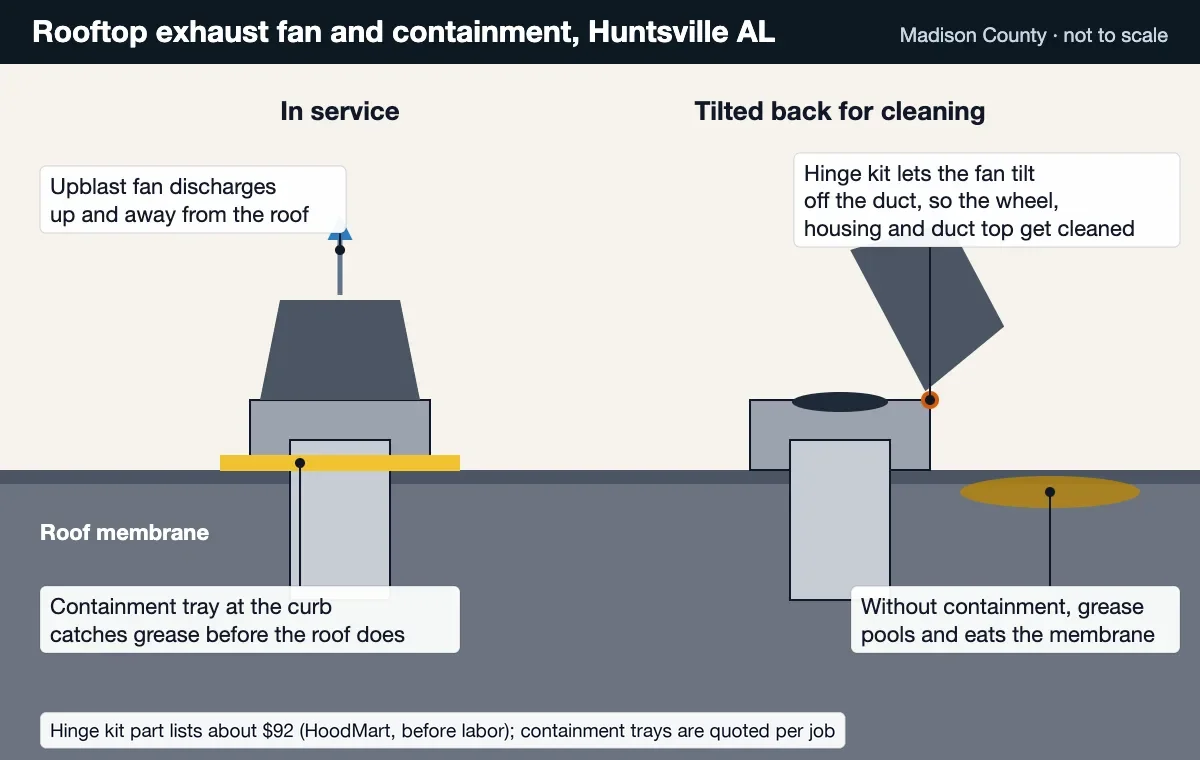
The exhaust fan is the last component every particle of grease-laden air passes through before it leaves your building, which makes it the single dirtiest part of a Huntsville kitchen exhaust system and the one most often skipped by a cheap cleaning crew. A hood cleaning that stops at the filters leaves the fan loaded, and a loaded fan quietly strangles the airflow that the rest of the system depends on.
Fan Wheel (Impeller)
The fan wheel is the primary component that moves air through the exhaust system. Grease builds up on the blades, reducing airflow and adding weight that stresses the motor bearings. Every blade surface should be degreased.
Scroll Housing
The curved housing surrounding the fan wheel accumulates grease on all interior surfaces. Cleaned using hot water and chemical degreasers to restore smooth airflow.
Intake Screen & Drain
The intake screen prevents larger debris from entering the fan. The drain at the fan base prevents grease from pooling and overflowing onto the rooftop.
Hinge Kit Installation
Fans without hinge kits cannot be tilted away from the duct opening, limiting access for cleaning. A comprehensive service installs hinge kits on fans that require them.
NFPA 96 Chapter 8: Hinge, Drain, and Access Requirements for Kitchen Exhaust Fans
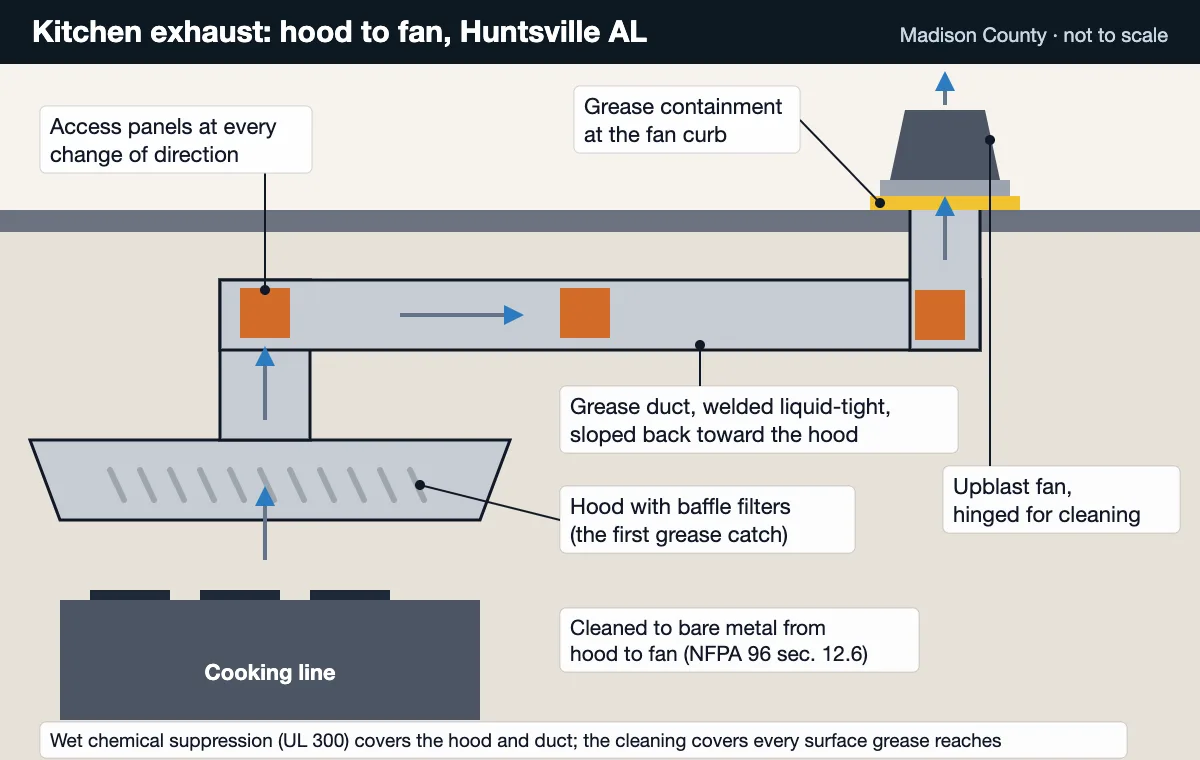
Chapter 8 of NFPA 96 governs air movement, and it puts three specific obligations on a rooftop up-blast fan that Huntsville Fire and Rescue inspectors can check from the roof in under a minute. Alabama reaches this standard from two directions. The State Fire Marshal enforces NFPA 101, whose Section 9.2.3 routes commercial cooking equipment to NFPA 96, and the City of Huntsville enforces the International Fire Code, whose Section 609 covers commercial kitchen hoods and points to the same standard.
Section 8.1.1.2 requires up-blast fans to be hinged and supplied with a flexible weatherproof electrical cable and a service hold-open retainer, so the fan can be tilted back off the curb and held there safely while the wheel and the duct inlet are cleaned. This is the clause behind hinge kits. A fan bolted flat to its curb with rigid conduit cannot be opened without disconnecting power and breaking the connection, so in practice it never gets opened at all, and the duct inlet directly beneath it never gets touched.
Section 8.1.1.3 requires the up-blast fan to have a drain directed to a readily accessible and visible grease receptacle not exceeding 1 gallon. Note both halves of that. The drain has to exist, and the container it feeds has to be visible, accessible, and small. Older fans on Meridianville and Hazel Green buildings often have no drain fitting at all, and newer ones sometimes have the 1 gallon container swapped for a 5 gallon bucket to stretch the emptying interval. Both are findings.
For in-line and utility set fans, Chapter 8 requires that the fan be installed with access for cleaning and be provided with a drain. Interior fans do not get a pass because they are inconvenient. They get access panels instead, and the panels have to be usable at every future service rather than sealed shut after the first one.
Cleaning frequency for the fan is not separate from the rest of the system. NFPA 96 Table 12.4 sets one schedule for the whole exhaust system: monthly for solid fuel, quarterly for high-volume and 24 hour operations, semiannually for most full-service restaurants, and annually for low-volume kitchens. Section 12.6 requires the complete system to be cleaned to bare metal where accessible, and the fan is explicitly part of that system. A certificate claiming a compliant cleaning on a system where the fan was never opened does not reflect what the code asked for.
Exhaust Fan Types Found Across Huntsville and Madison County
Huntsville kitchens span 1950s Downtown storefronts, 1990s strip retail along Jordan Lane and University Drive, institutional dining at Redstone Arsenal and the Huntsville Hospital campuses, and build-outs finished in the last five years around Providence, MidCity, and Town Madison. Each era brought a different fan. What follows is what turns up on those roofs and in those mechanical spaces.
Up-Blast Centrifugal Roof Fan
The standard Type I kitchen exhaust fan and the one on most Huntsville restaurant roofs. Discharges vertically away from the membrane, hinges back off the curb for cleaning, and drains to a container at the base. Listed under UL 762 for restaurant exhaust duty. If yours has no hinge, no hold-open retainer, or no flexible service cable, it is not meeting NFPA 96 Section 8.1.1.2.
Utility Set and In-Line Fans
Used where a rooftop unit is not practical, which covers a good share of multi-story Downtown tenant spaces and interior food court kitchens. The wheel is enclosed in a housing with no tilt-out access, so cleaning runs through access panels. NFPA 96 Chapter 8 still requires access for cleaning and a drain on these, and the drain is the part most often missing.
Belt-Drive vs. Direct-Drive
Belt-drive fans use a motor mounted outside the airstream with a belt and sheaves, so belt wear and sheave alignment become part of the service. Direct-drive units have fewer wear parts but the motor sits closer to the grease path. Belt tension and glazing should be checked at every visit on belt-drive units because a slipping belt reads on the roof as a fan that is running fine.
Solid Fuel Exhaust Fans
Wood-fired and charcoal operations produce creosote and particulate along with grease, and NFPA 96 puts these systems on a monthly Table 12.4 schedule. The fan wheel on a solid fuel line loads faster and with a harder, more baked-on deposit than a fryer line. These almost always need a hinge kit and frequently need the wheel pulled.
Make-Up Air Interlock
The mechanical code Huntsville enforces requires replacement air at roughly the volume being exhausted. When a make-up air unit is undersized, failed, or wired so it does not start with the hood, the kitchen goes negative and the exhaust fan cannot pull its rated airflow no matter how clean it is. A good cleaner flags this when the symptoms point to it, because cleaning a fan will not fix a building that has no air to give it.
Water-Wash Hood Fans
Institutional kitchens across Madison County, including hospital, school system, and Redstone Arsenal dining facilities, often run water-wash hoods. The detergent cycle handles the extractor face only. The duct and the exhaust fan downstream still load with grease and still require manual cleaning on the normal NFPA 96 schedule.
What a Grease-Loaded Fan Wheel Actually Costs You
Operators tend to think of fan cleaning as a fire code box to tick. The fire risk is real, and a grease-saturated wheel sitting above a hot motor is a genuine ignition source, but the everyday cost of a dirty fan shows up long before anything catches. It shows up as a kitchen that is too hot, a dining room that smells like a fryer, and a repair bill on a motor that should have lasted another decade.
Grease deposits on the blades change the wheel's profile and add unbalanced mass. The airflow penalty comes first: a wheel designed to move a given volume moves noticeably less, and capture velocity at the hood lip falls with it. The mechanical penalty follows. An out-of-balance wheel runs a vibration into the bearings and the shaft every hour the kitchen is open, and bearing replacement on a rooftop fan is a service call plus parts plus a kitchen that cannot cook while the fan is down.
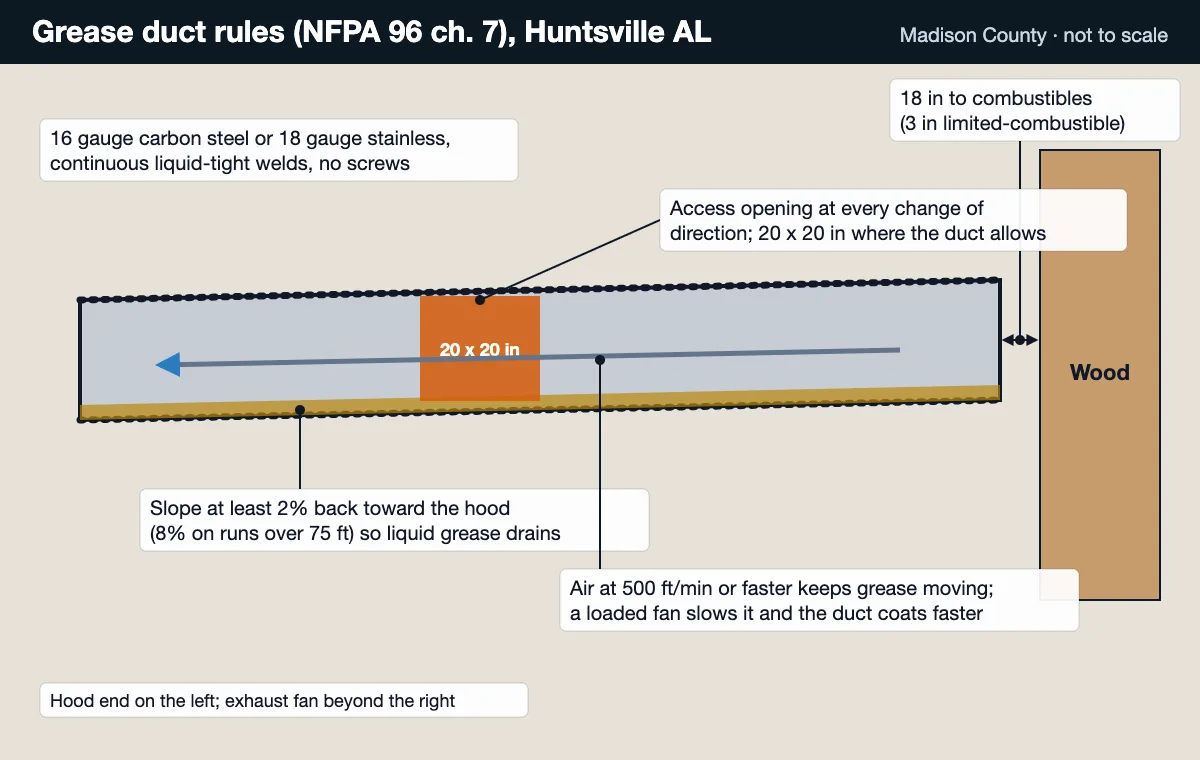
Then there is the downstream effect on the rest of the system. When duct velocity drops below the 500 feet per minute NFPA 96 sets as the minimum, grease stops being carried through the duct and starts dropping out onto the duct walls. The duct loads faster, the next cleaning takes longer and costs more, and the grease that used to reach the fan now sits in a horizontal run over your ceiling instead. One neglected component pulls the whole system out of its maintenance economics.
Finally, the building goes negative. Huntsville summers put real load on a kitchen, and a hood that is not capturing properly dumps that heat into the space instead of out through the roof. Staff notice it before an inspector does. If your cooks have started propping the back door open in July, the fan is worth looking at before you look at the HVAC.
Exhaust Fan Service Pricing in Huntsville (2026)
Fan cleaning is not a separate line item. Wheel, scroll housing, intake screen, and drain are included in the base hood cleaning, which the National Hood Cleaners Association put at $450 to $1,200 per visit for a standard full-service restaurant in 2026 and $600 to $1,800 for a high-volume or multi-hood kitchen. What gets quoted separately are the one-time and wear items, and those are worth knowing in advance so an invoice never surprises you.
A hinge kit is the single best value on this list (the standard kit lists around $92 at HoodMart, plus installation), because it is a one-time cost that makes every future cleaning faster and turns an inaccessible duct inlet into a serviceable one. A fan belt is a small part, V-belts list from $25 for three, so the visit and labor set that bill. A rooftop containment tray at the fan curb and a standalone rooftop grease cleanup are quoted per job, by fan footprint and how far grease has spread. A wheel that has to be pulled off the shaft because buildup is too heavy to clean in place adds labor to that visit.
Fan work is usually scheduled overnight or early morning so the kitchen is back in service before the first cover. Roof access matters to the quote: a hatch or a fixed ladder is standard, while the taller Downtown and Cummings Research Park properties that need a lift are quoted separately. Annual service agreements covering the required number of visits for your Table 12.4 category are usually priced below one-off visits; ask for both prices.
Request Service Before the Next Scheduled Visit If You Notice Any of These
Kitchen Exhaust Fan Cleaning in Huntsville, AL: Frequently Asked Questions
What does exhaust fan cleaning include?
Fan wheel (impeller) degreasing, scroll housing cleaning, motor compartment exterior wipe-down, intake screen cleaning, and drain check. If a hinge kit is installed, the fan tilts away from the duct opening for full internal cleaning.
What is a hinge kit and does my fan need one?
A hinge kit is a mounting bracket that allows the exhaust fan to tilt away from the duct opening, giving technicians clear access to the duct inlet and the fan's internal components. Without one, cleaning is limited to what can be reached through the fan's access screen. NFPA 96 Section 11.4 requires that exhaust fans be capable of being positioned to allow adequate cleaning.
How often should the exhaust fan be cleaned?
The exhaust fan is part of the complete exhaust system and should be cleaned at the same frequency as the hood: monthly for solid-fuel operations, quarterly for high-volume kitchens, and semi-annually for most restaurants. The fan accumulates grease quickly because all grease-laden air passes through it on the way to the atmosphere.
What happens if the exhaust fan is not cleaned?
A grease-coated fan wheel loses efficiency over time, reducing airflow through the exhaust system. Reduced airflow means more grease reaches the duct walls rather than being captured by filters. In severe cases, a grease-saturated fan can ignite from motor heat or a spark from the duct below.
Why does my kitchen smoke roll out into the dining room even though the fan is running?
A fan that spins is not the same as a fan that moves air. Grease loading on the wheel changes the blade profile and adds mass, and a wheel that has gone 18 months without service can lose a large share of its rated airflow while sounding completely normal from the roof. NFPA 96 Section 7.8.1.1 sets a minimum duct velocity of 500 feet per minute for exactly this reason. Once velocity drops below that, grease stops being carried to the fan and starts settling on the duct walls instead, and capture at the hood lip gets weak enough that smoke spills into the dining room on a busy Friday.
Do in-line and utility set fans get cleaned too, not just rooftop up-blast fans?
Yes. Plenty of Huntsville kitchens in multi-story and interior-tenant spaces, including several Downtown buildings and the mall food court properties, run utility set or in-line fans rather than a rooftop up-blast unit. NFPA 96 Chapter 8 requires these to be installed with access for cleaning and to be provided with a drain. In practice they are harder to service than a hinged rooftop fan because the wheel sits inside a housing with no tilt-out access, so panel access and a longer service window matter.
Should the exhaust fan keep running if the fire suppression system discharges?
In most listed configurations, yes. NFPA 96 expects the exhaust fan to continue operating during and after a wet chemical discharge so that products of combustion and the discharged agent keep moving out of the building instead of back into the kitchen. The exception is a system specifically listed to require fan shutdown. This is worth confirming with whoever services your suppression system, because a fan wired to shut down on a UL 300 discharge when the listing does not call for it is a finding a Huntsville Fire and Rescue inspector can write up on its own.
How much does exhaust fan service cost in Huntsville?
Fan wheel, housing, intake screen, and drain cleaning is included in the base hood cleaning price, which the National Hood Cleaners Association put at $450 to $1,200 per visit for a standard full-service restaurant in 2026 and $600 to $1,800 for a high-volume or multi-hood kitchen. The add-ons are what vary and are quoted separately: a hinge kit (the part lists around $92 at HoodMart before labor) is a one-time cost that makes every future service faster, a worn belt is a small part (V-belts from $25 for three) plus the visit, and a wheel too heavily loaded to clean in place adds time to that visit.