Grease Duct Cleaning in Huntsville, AL
Grease duct cleaning in Huntsville takes exhaust duct interiors to bare metal from the hood collar to the rooftop fan, with access panels installed wherever a section cannot otherwise be reached. Serving Huntsville and Madison County kitchens.
NFPA 96 requires that the entire exhaust duct interior be cleaned, not just the visible hood surfaces. Grease accumulates on duct walls, especially at horizontal runs and elbows, and is the primary path for a duct fire to spread.
What Grease Duct Cleaning Includes
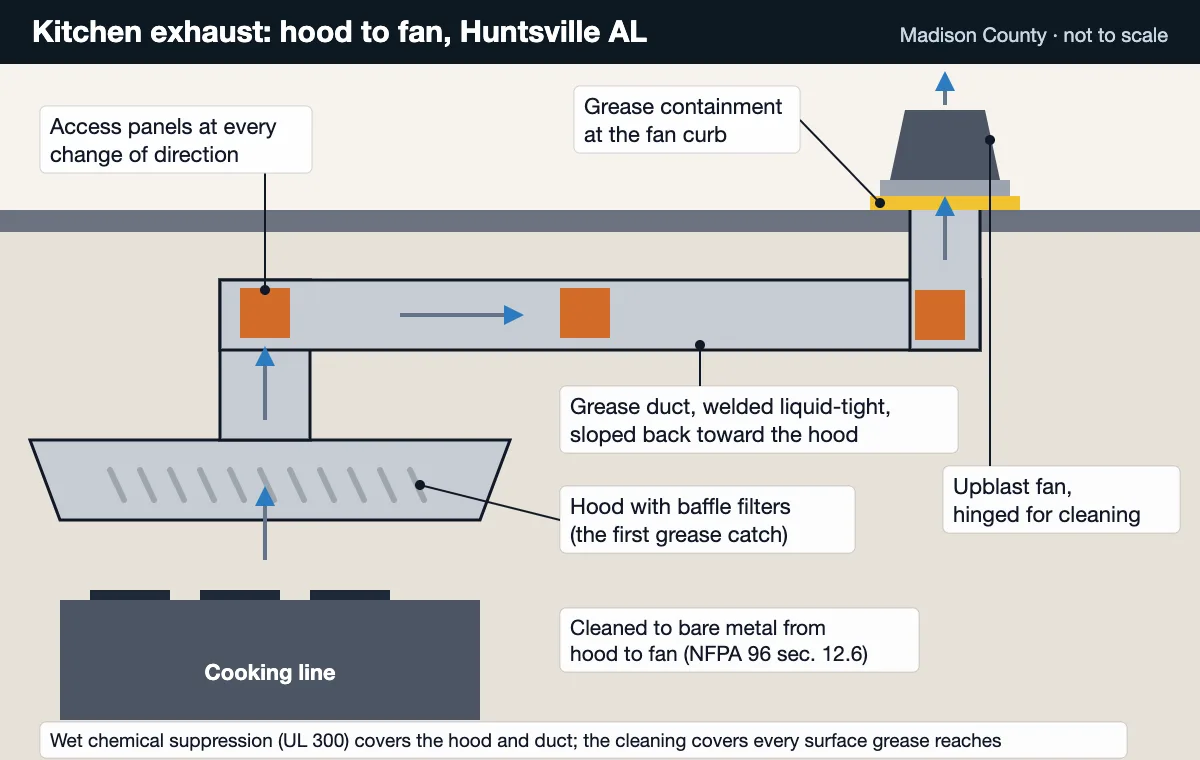
The duct is the part of your exhaust system nobody looks at and the part where a kitchen fire actually travels. A hood you can see is easy to keep presentable. A duct run above a dropped ceiling in a Downtown Huntsville building, or threading three floors of a hotel to a roof curb, is invisible until somebody opens a panel. That is the whole reason NFPA 96 treats duct cleaning as a requirement in its own right rather than a bonus on top of a hood wipe-down.
Duct Interior Degreasing
High-pressure hot water and chemical degreasers applied to all interior duct surfaces from the hood collar to the fan. Grease is scraped and flushed from walls, particularly at horizontal runs and elbows where accumulation is highest.
Access Panel Installation
Panels installed at required NFPA 96 intervals (typically every 12 feet on horizontal runs and at every change of direction) so every section can be reached and cleaned at each service.
Full-Length Coverage
Service extends from the hood collar, through all horizontal and vertical duct runs, to the fan inlet. No section is skipped.
Documentation
Written report documenting all duct sections cleaned, access panels installed or found, and grease levels before and after service. Required for fire marshal compliance.
Why Duct Cleaning Is Required Separately Under NFPA 96
NFPA 96 Section 12.6 specifically requires that the complete exhaust system be cleaned, which includes the duct interior. A hood-only cleaning does not satisfy the standard. An inspector checking a system where only the hood was cleaned but the duct has visible grease accumulation will issue a violation even if the hood surface looks clean.
Most grease fires in commercial kitchens do not start at the hood. They start inside the duct, often triggered by a cooking flare-up that throws a flame into the hood, igniting grease on the duct walls. The fire then travels upward through the duct to the rooftop.
NFPA 96 Chapter 7: Construction, Clearance, Slope, and Access Openings
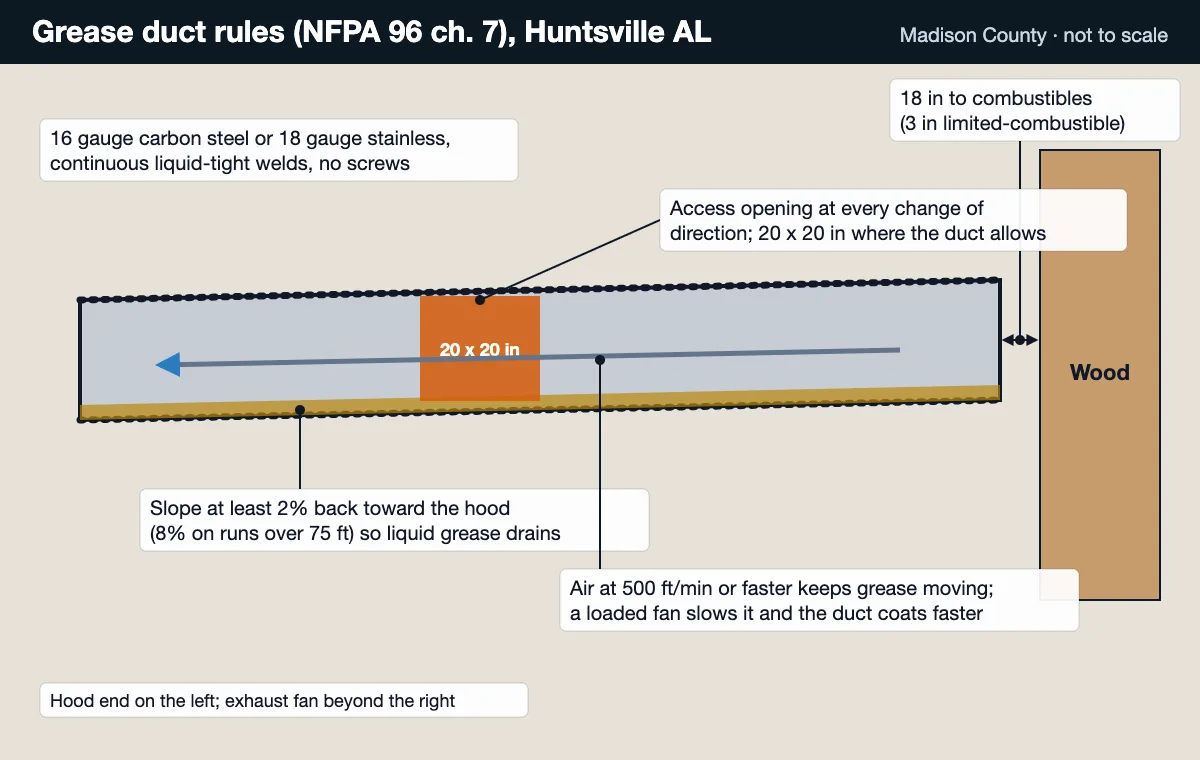
Chapter 7 of NFPA 96 governs exhaust duct systems, and it is the chapter that decides whether your duct can be cleaned at all. Alabama gets to this standard through the State Fire Marshal's adoption of NFPA 101, whose Section 9.2.3 routes commercial cooking equipment to NFPA 96, and the City of Huntsville reaches the same place through the International Fire Code and its Section 609 on commercial kitchen hoods.
Construction comes first. Grease duct is required to be built from carbon steel of at least 16 gauge or stainless steel of at least 18 gauge, and every seam, joint, and penetration has to be a liquid-tight continuous external weld. That last phrase is doing real work. A duct assembled with screws and sealant is not a grease duct, and grease that finds its way through a non-welded seam ends up inside a wall or ceiling cavity where no cleaning contractor will ever reach it.
Clearance comes next. Section 7.5.1 requires 18 inches from the duct to combustible material, 3 inches to limited-combustible, and no clearance to noncombustible, unless a listed clearance reduction method or a listed grease duct enclosure is used. In Huntsville's older building stock, particularly the Downtown and Five Points storefronts that have been through three or four restaurant tenants, this is the requirement that is most often compliant on the day of inspection and quietly violated two years later when someone builds a shelf or a soffit against the duct.
Slope is the requirement almost nobody knows. NFPA 96 requires horizontal duct to be installed with a slope of not less than 2 percent back toward the hood or an approved reservoir, increasing to not less than 8 percent on horizontal runs longer than 75 feet. The point is drainage: liquid grease should run back to a place you can service rather than pooling in a low spot over your dining room. Long flat runs, and runs that have sagged between hangers over decades, are where standing grease shows up rather than film.
Then access. Section 7.3 requires openings at the sides or top of the duct, whichever is more accessible, and at every change of direction. On horizontal ducts, at least one 20 inch by 20 inch opening is required for personnel entry where the duct is large enough to permit it, and where an opening that size is not possible, cleaning openings are required at intervals of no more than 12 feet. Openings must not be placed in inaccessible locations, and panels need to be identified so that a later remodel does not bury them behind drywall.
Finally, airflow. Section 7.8.1.1 sets a minimum duct air velocity of 500 feet per minute. Below that, grease stops being transported and starts being deposited. This is the number that links a neglected exhaust fan to an accelerating duct problem: a loaded fan wheel drops system velocity, and the duct that used to stay reasonably clear between services starts loading faster every cycle.
Where Grease Actually Collects in a Huntsville Duct Run
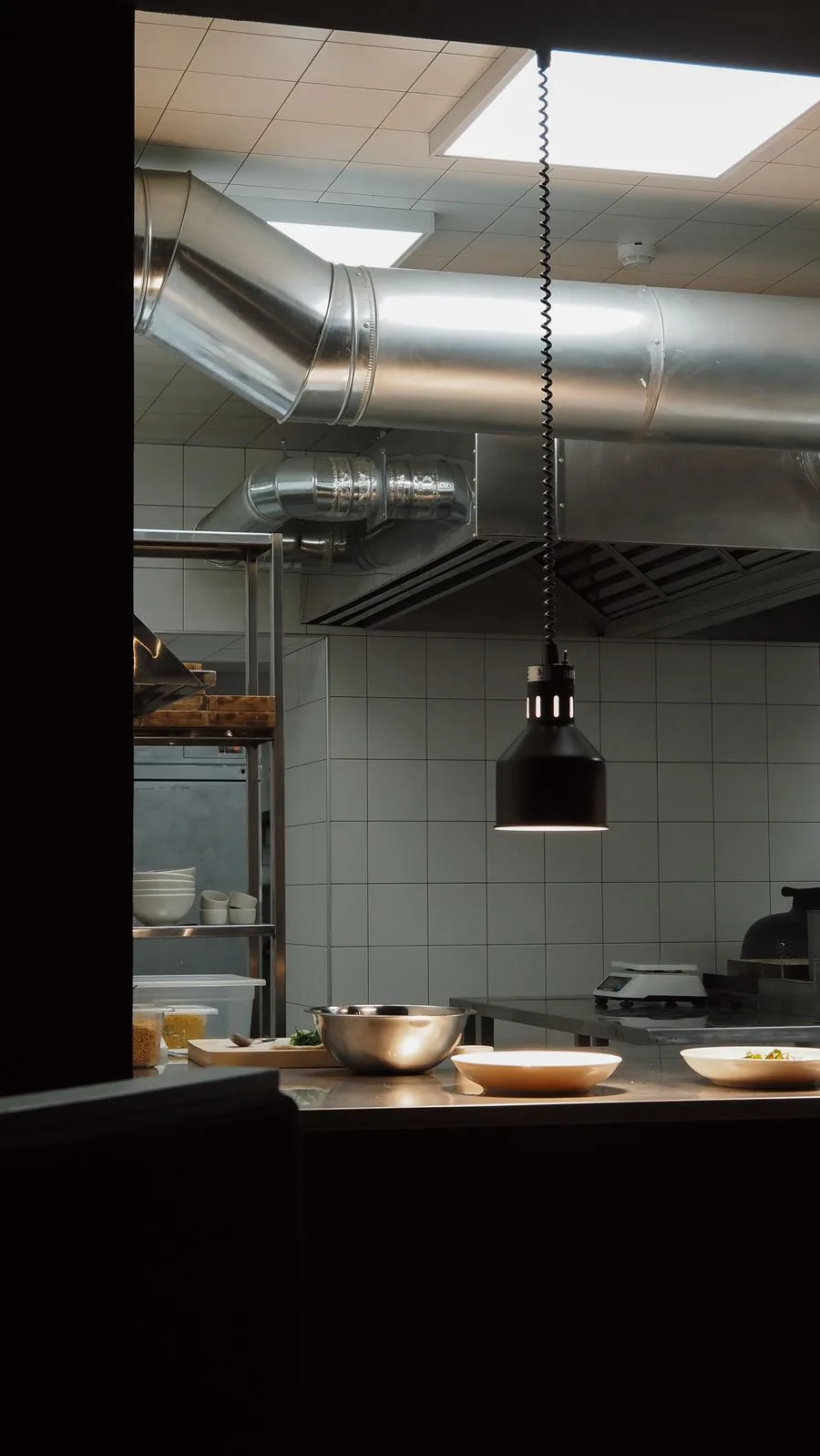
Grease does not coat a duct evenly. It drops out where the airstream slows or turns, which means a handful of predictable locations carry most of the fuel load in any system. Knowing where they are is how you tell a real duct cleaning from a cosmetic one, because a contractor who only opened the hood collar will leave every one of the other five untouched.
Hood Collar and First Elbow
The heaviest deposits in most systems. Grease-laden air leaves the plenum, hits the first change of direction, and drops what it is carrying. If your contractor can only reach one section of duct, this is the one they will reach, and it is also the one that makes a hood look well maintained while the rest of the run is untouched.
Horizontal Runs Over Ceilings
The slow accumulator. NFPA 96 requires horizontal duct to slope at least 2 percent back toward the hood, and 8 percent on runs over 75 feet, so liquid grease drains instead of pooling. Runs that were installed flat, or that sagged between hangers over twenty years, hold standing grease in the low spots. Common in older Downtown and Five Points buildings where the fan could not sit directly over the kitchen.
Transitions and Size Changes
Anywhere the duct changes dimension, velocity changes with it. NFPA 96 Section 7.8.1.1 puts the minimum at 500 feet per minute, and a transition that drops the airstream below that turns the section immediately downstream into a collection point.
Vertical Riser Base
Grease running back down a vertical riser stops at the bottom. In a multi-story kitchen, which describes a number of Downtown and hotel operations in Huntsville, the riser base can be holding years of accumulation that nobody has ever opened a panel to look at.
Fan Inlet and Curb
The last few feet before the fan wheel, directly under the roof curb. Reachable only if the fan hinges back off the curb, which is why NFPA 96 Section 8.1.1.2 requires up-blast fans to be hinged with a hold-open retainer. A fan bolted flat means this section never gets cleaned.
Concealed Sections With No Access
Not a location so much as a condition. Any run without an access panel is a section that cannot be cleaned to bare metal and therefore cannot satisfy Section 12.6.2. These are the sections that produce the surprise findings, because nobody, including the previous cleaning contractor, has ever seen inside them.
Access Panel Retrofits: The Cheapest Compliance Fix There Is

If your duct has no access panels, nothing else on this page can be done properly. A cleaning contractor working only from the hood collar and the fan end can reach the first several feet at either extreme and nothing in between. On a short single-story strip retail run, that might cover most of the duct. On a 40 foot horizontal run over a Downtown dining room, it covers a fraction of it, and the middle of the run is where the slope and the low spots are.
Retrofit panels are quoted per panel, by duct gauge, position, and whether the section sits above a finished ceiling. Most single-story restaurant systems need two to four. The panels are hinged and gasketed, they become permanent parts of the system, and they make every subsequent service faster, which shows up in the price of the next cleaning rather than just in the compliance status.
Two practical notes. First, panels have to stay reachable. Remodeled Huntsville spaces sometimes turn out to have panels drywalled over by a contractor who had no idea what they were, which puts the system right back to uncleanable. Second, panel placement should be planned against the code intervals rather than against where the ladder happens to reach, because a panel in a convenient spot that leaves a 20 foot gap satisfies nobody.
Signs Your Duct Is Not Being Fully Cleaned
Duct Cleaning Frequency and 2026 Huntsville Pricing
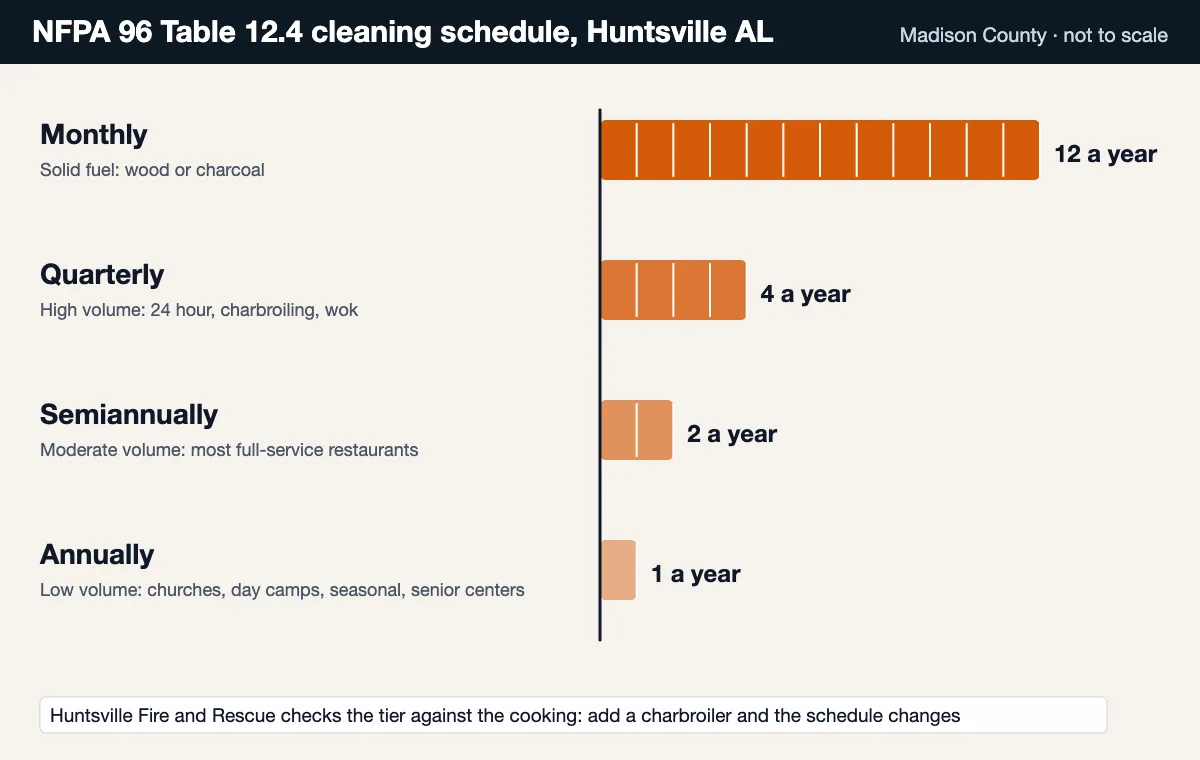
Duct cleaning is not billed separately. It is part of the complete system service, which the National Hood Cleaners Association put at $450 to $1,200 per visit for a standard full-service restaurant in 2026, $600 to $1,800 for a high-volume or multi-hood restaurant, and $1,000 to $3,500 or more for hotels, hospitals and other complex systems. Solid fuel kitchens pay their size tier per visit, but on the monthly interval NFPA 96 Table 12.4 requires, so they budget for twelve visits a year.
Duct length is the single biggest variable inside those ranges. A single-story kitchen in a Madison or Providence strip center might run 10 to 15 feet from hood collar to roof curb. A multi-story Downtown or hotel kitchen can run 30 to 50 feet through walls and ceilings with two or three changes of direction, and every section adds time. Grease condition is the second variable. A system that has gone 18 months without service takes materially longer than the same system on a maintained schedule, which is why deferring a cleaning rarely saves what operators expect it to.
Most service is scheduled overnight or early morning so the kitchen is back in service before the next cover, and annual service agreements covering the required number of visits for your Table 12.4 category are usually priced below one-off visits; ask for both prices side by side. Access panel installation, hinge kits, filter replacement, and rooftop containment should be quoted as separate line items so you can see exactly what the base cleaning covers and what it does not.
Grease Duct Cleaning in Huntsville, AL: Frequently Asked Questions
Why does the duct need to be cleaned separately from the hood?
Grease migrates past the filters and accumulates on the duct walls, especially at elbows and horizontal runs. NFPA 96 requires cleaning of the complete exhaust system, including duct interiors, not just the visible hood surfaces. A hood that looks clean can still have dangerous grease levels inside the duct.
How is the inside of the duct accessed for cleaning?
Cleaners use extension tools and high-pressure hot water to reach duct interiors from the hood collar and fan end. For long or complex duct runs, hinged access panels get installed at standard intervals so every section can be reached and the panel can be re-opened at the next service.
What are access panels and does my duct need them?
Access panels are inspectable openings cut into the duct and fitted with hinged, gasketed covers. NFPA 96 requires access panels at specified intervals so that every section of duct can be inspected and cleaned. If your duct does not have panels, it cannot be fully serviced and a fire marshal inspection may flag the system as non-compliant.
How often should grease ducts be cleaned in Huntsville?
The same schedule as the hood: monthly for solid-fuel operations, quarterly for high-volume or 24-hour kitchens, semi-annually for most restaurants, and annually for low-volume operations. Duct cleaning is included in every complete service visit.
How much does access panel installation cost in Huntsville?
Retrofit access panels are quoted per panel, because the price depends on duct gauge, position, and whether the section is concealed above a ceiling; no Huntsville company publishes a rate, and the National Hood Cleaners Association lists access panels among the add-ons usually priced outside the cleaning. A typical single-story strip retail duct run needs two to four panels. It is a one-time cost, the panels become permanent parts of your system, and every future cleaning is faster and more complete because of them. A duct that cannot be opened cannot be cleaned to bare metal, which means it cannot be brought into compliance with NFPA 96 Section 12.6.2 no matter who you hire.
Why does grease collect more in some parts of my duct than others?
Because velocity and direction change. NFPA 96 Section 7.8.1.1 sets a minimum duct air velocity of 500 feet per minute, and grease stays airborne only while that velocity holds. Every elbow, transition, and horizontal run slows the airstream and gives droplets a chance to drop out and stick. That is why the heaviest deposits in a Huntsville duct are almost always at the first elbow off the hood collar, along horizontal runs over a dropped ceiling, and at the fan inlet, rather than evenly spread along the duct.
My duct runs horizontally over the dining room ceiling. Does that change anything?
It changes the risk profile and the access requirements. NFPA 96 requires horizontal duct to slope not less than 2 percent back toward the hood or an approved reservoir so liquid grease drains rather than pools, and 8 percent on runs longer than 75 feet. It also requires personnel entry openings or cleaning openings at intervals along the run. Long horizontal runs over occupied space are common in Downtown Huntsville and Five Points buildings where the fan could not be put directly above the kitchen, and they are exactly where an uncleaned section turns into a ceiling stain or worse.
What clearance does my grease duct need to combustible material?
NFPA 96 Section 7.5.1 requires 18 inches of clearance from a grease duct to combustible material, 3 inches to limited-combustible material, and no clearance to noncombustible material, unless a listed clearance reduction method or a listed grease duct enclosure is used. This is the requirement that most often forces a redesign during plan review in older Huntsville buildings, where a duct has to thread through framing that simply does not offer 18 inches. It is also worth checking after any remodel, because shelving, soffits, and storage added later can quietly eat a clearance that was compliant on the day it was inspected.