NFPA 96 Compliance Guide for Huntsville, Alabama Restaurants
NFPA 96 is the fire standard Huntsville Fire & Rescue enforces for kitchen exhaust systems in Huntsville and Madison County, Alabama. This guide covers its cleaning schedules, grease depth triggers, and inspection checks, written for restaurant owners and kitchen managers.
What Is NFPA 96?
NFPA 96 is the Standard for Ventilation Control and Fire Protection of Commercial Cooking Operations, published by the National Fire Protection Association. It is the primary national code governing commercial kitchen exhaust systems and is adopted and enforced by fire marshals across Alabama, including Huntsville Fire & Rescue.
The standard covers the design, installation, operation, inspection, and maintenance of commercial cooking exhaust systems. For restaurant operators, the most relevant sections are Chapter 11 (exhaust system equipment) and Chapter 12 (cleaning and inspection).
The newest edition is the 2024 edition, but the edition enforced is the one your fire department or code adopted: Madison works from the 2021 IFC and its referenced NFPA codes, and CMS surveys hospitals against the 2011 edition. A 2027 edition is under development.
NFPA 96 Cleaning Frequency Requirements (Table 12.4)
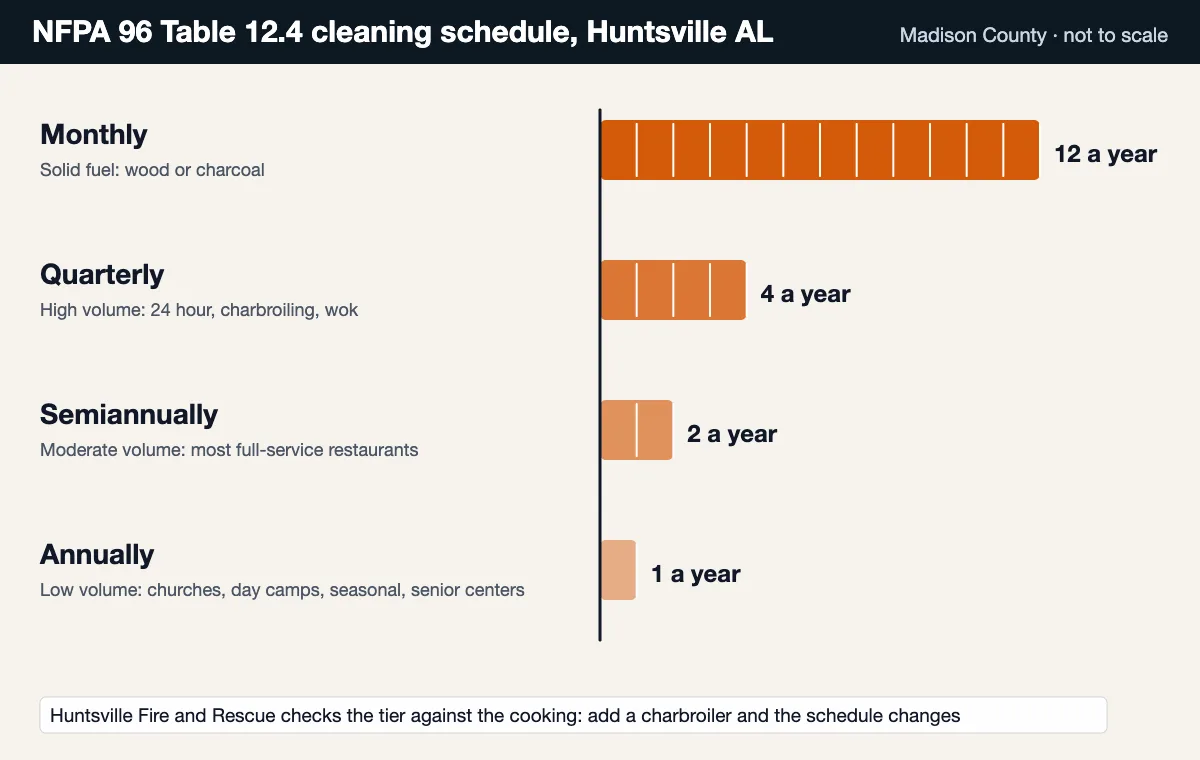
NFPA 96 Table 12.4 sets the minimum inspection frequency by kitchen type. Many operators ask "how often do I need to clean my hood" and the answer is Table 12.4, based on the type of cooking you do:
Table 12.4 sets the inspection schedule. If grease levels exceed the depth thresholds in Section 12.6.1.1 before your next scheduled date, cleaning is required immediately.
Section 12.6.1.1: Grease Depth Cleaning Triggers
Separate from the inspection schedule, NFPA 96 Section 12.6.1.1 requires cleaning any time grease depth exceeds specific thresholds. These apply at any time, not just at your next scheduled service date:
The two numbers do different jobs. 0.078 and 0.125 inch are triggers: an inspection that measures that much grease means the system is cleaned now, whatever the calendar says. 0.002 inch is the finish line: the most grease a surface may keep after cleaning, which is why a wipe-down that leaves a film does not count as a cleaning. Readings are taken with a depth gauge comb, a notched card pressed onto the surface; see kitchen hood inspection for how that visit works.
Section 12.6.2: Proactive Maintenance Requirement
NFPA 96 Section 12.6.2 requires that exhaust systems be maintained before surfaces become heavily contaminated. This means the cleaning schedule must be followed proactively, not only after grease builds up to the threshold limits. It also means that if your kitchen is producing more grease-laden air than the minimum schedule anticipates (for example, if you have added menu items with higher fat content), you may need to clean more frequently.
What NFPA 96 Requires in Your Compliance Documentation
After each cleaning, NFPA 96 requires that the service be documented. The documentation must include, at minimum:
- Date of cleaning
- Identity of the person or company that performed the cleaning
- Areas cleaned
- Method of cleaning
In practice, Huntsville Fire & Rescue inspectors also look for the cleaning certificate affixed to the hood (with the next service date), the technician's certification, and grease level documentation. A good service report goes beyond the minimum NFPA 96 documentation standard.
How Huntsville, AL Enforces NFPA 96
Huntsville Fire & Rescue and Madison County fire authorities enforce NFPA 96 through routine commercial kitchen inspections. When an inspector arrives at your restaurant, they are looking for:
The Alabama Department of Public Health (ADPH) separately inspects food establishments under Chapter 420-3-22 for food safety compliance. ADPH inspectors evaluate ventilation system maintenance as part of their food safety assessment. A dirty or overdue exhaust system can result in a food safety violation separate from the fire code violation.
Consequences of Non-Compliance in Huntsville
Ready to Get Compliant?
We serve restaurants, cafeterias, hospitals, hotels, and commercial kitchens throughout Huntsville and Madison County. Every service should include NFPA 96-compliant documentation.
NFPA 96 Compliance FAQ
What is NFPA 96?
NFPA 96 is the Standard for Ventilation Control and Fire Protection of Commercial Cooking Operations, published by the National Fire Protection Association. It is the primary code governing commercial kitchen exhaust systems in the United States and is adopted and enforced by fire marshals in Alabama including Huntsville Fire & Rescue.
How often must I clean my hood under NFPA 96 in Huntsville?
The cleaning schedule is based on your kitchen type: monthly for solid-fuel operations (wood, charcoal), quarterly for high-volume or 24-hour operations, semi-annually for most full-service restaurants, and annually for low-volume or seasonal operations. Table 12.4 names 24-hour cooking, charbroiling and wok cooking as high volume.
What grease depth requires immediate cleaning under NFPA 96?
NFPA 96 Section 12.6.1.1 uses a depth gauge comb: a reading of 0.078 inch (2,000 microns) on hood, plenum or duct surfaces, or 0.125 inch (3,175 microns) inside a fan housing, means the surface must be cleaned, however recently the last scheduled service was performed. After cleaning, no more than 0.002 inch (50 microns) may remain.
Is there an NFPA 96 certification for hood cleaners?
NFPA writes the standard but does not certify hood cleaners. NFPA 96 asks for inspection and cleaning by a properly trained, qualified and certified person acceptable to the authority having jurisdiction, and the industry credentials that fill that role come from trade bodies: IKECA's Certified Exhaust Cleaning Technician (CECT), Specialist (CECS) and Exhaust System Inspector (CESI), plus programs such as Phil Ackland Training and CHDCA. When hiring, ask which credential the technician holds and its number.
Does NFPA 96 apply in Huntsville, AL?
Yes. NFPA 96 is adopted by Alabama fire authorities and enforced by Huntsville Fire & Rescue for all commercial kitchens in the city and Madison County. Compliance with NFPA 96 is also a standard requirement in most commercial property insurance policies and food establishment lease agreements.