How Much Does Hood Cleaning Cost in Huntsville, AL?
Hood cleaning in Huntsville typically costs $450 to $1,200 per visit for a full-service restaurant, $300 to $700 for a light-use single hood and $600 to $1,800 for busy multi-hood kitchens, using the 2026 national ranges because no local company publishes prices. Your yearly cost is that price times the visits NFPA 96 sets for your cooking.
Hood Cleaning Price Ranges in Huntsville
The main factors driving price are kitchen type (what you cook and how intensely), system complexity (hood size, duct length, number of fans), and cleaning frequency. No Huntsville company publishes prices, so these are the 2026 national ranges from the National Hood Cleaners Association, which fit a Huntsville quote comparison well:
These are typical ranges for complete system cleaning (hood, filters, duct, fan). Estimates require an on-site assessment because duct length and grease condition vary significantly. Send your kitchen details through the quote form for a quote.
What Drives the Cost of Hood Cleaning
Add-On Service Costs
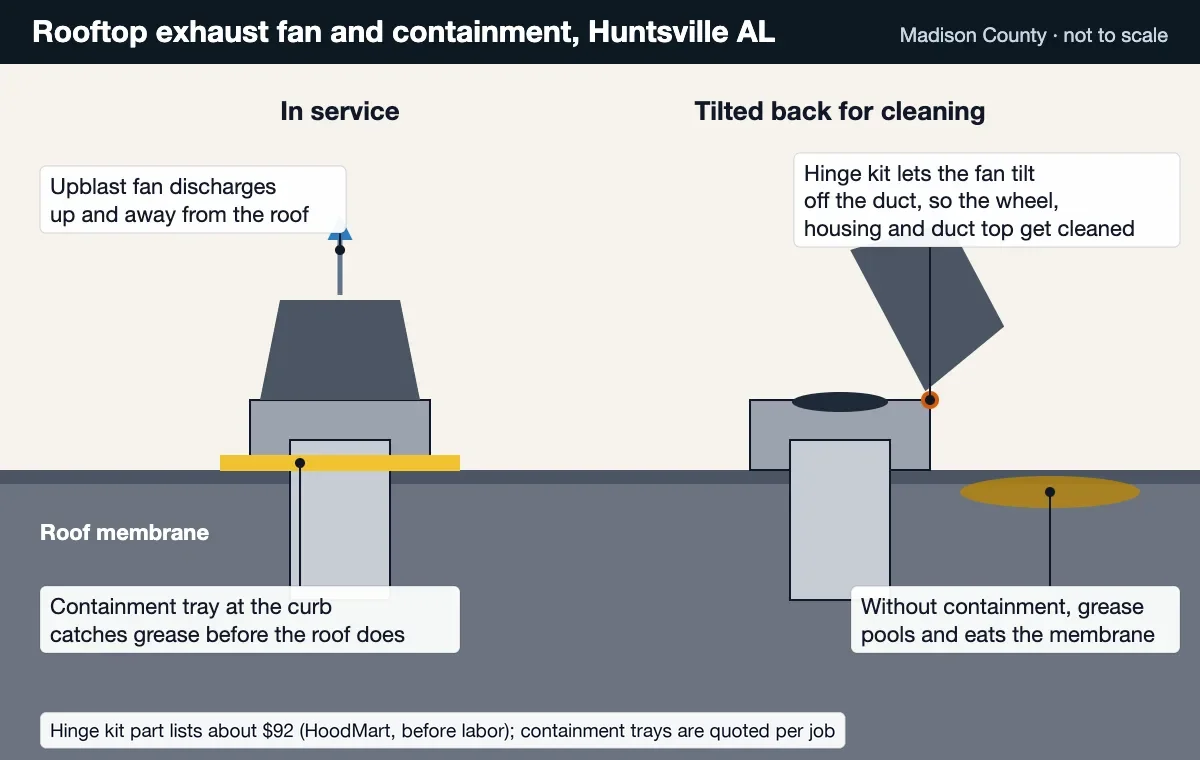
Add-ons are where quotes differ most, and nobody in Huntsville publishes them. The National Hood Cleaners Association lists filters, fan belts and bearings, fan motors, electrical work, access panels, hinge kits and containment as the usual exclusions from a cleaning price. Where a parts price is published, it is shown below as a floor; labor comes on top.
The True Cost of Skipping Hood Cleaning
The cost of a missed or overdue cleaning extends well beyond the cleaning invoice. Grease in a duct is fuel that sits out of sight above the cook line. Fire marshal enforcement in Huntsville means non-compliance has real consequences:
Insurance carriers also require documented cleaning compliance. A grease fire loss on a system with overdue service documentation can result in a denied claim.
Why the First Cleaning Costs More Than the Ones After It
Nearly every operator coming back from a lapse asks the same question: why is the first number higher than the price you quoted for ongoing service. The answer is that they are two different jobs. The first visit on a neglected system is a restoration clean. Everything after it is a maintenance clean, and maintenance is cheap precisely because restoration already happened.
NFPA 96 Section 12.6.2 sets the standard: hoods, grease removal devices, fans, ducts, and appurtenances are to be cleaned to bare metal, and are to be maintained before surfaces become heavily contaminated. Grease that has been sitting on a duct wall through two Huntsville summers is not the same material as grease from six months ago. Heat, time, and repeated cycling polymerize it into a hard, varnish-like layer that needs longer chemical dwell, more passes, and in places physical scraping. A restoration clean on a badly overdue system is therefore quoted well above the ongoing maintenance price for the same kitchen.
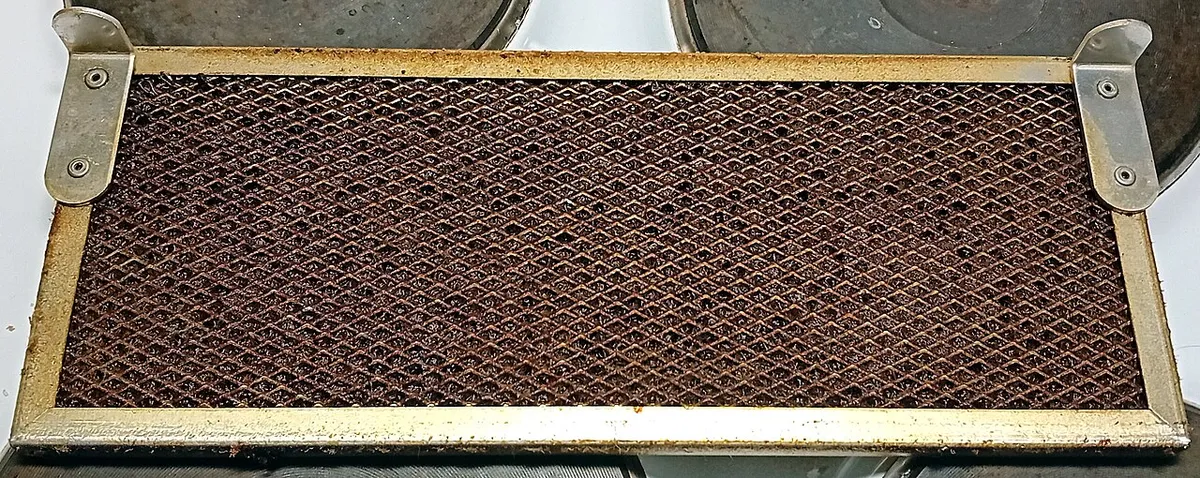
Two other costs tend to land on that same first visit. Access panels, if the system has none, because there is no way to clean what cannot be opened. And filters, because a set that has gone years without a proper caustic wash often has warped baffles or failed spot welds that put them past cleaning. Neither should be a surprise at the end. Both should be quoted before the work starts.
The upside is that the restoration cost is one-time. Once the system is at bare metal and has panels where the code requires them, your kitchen settles into the normal range for its size and its Table 12.4 schedule and stays there as long as the schedule holds.
Service Agreements Versus Paying Per Visit
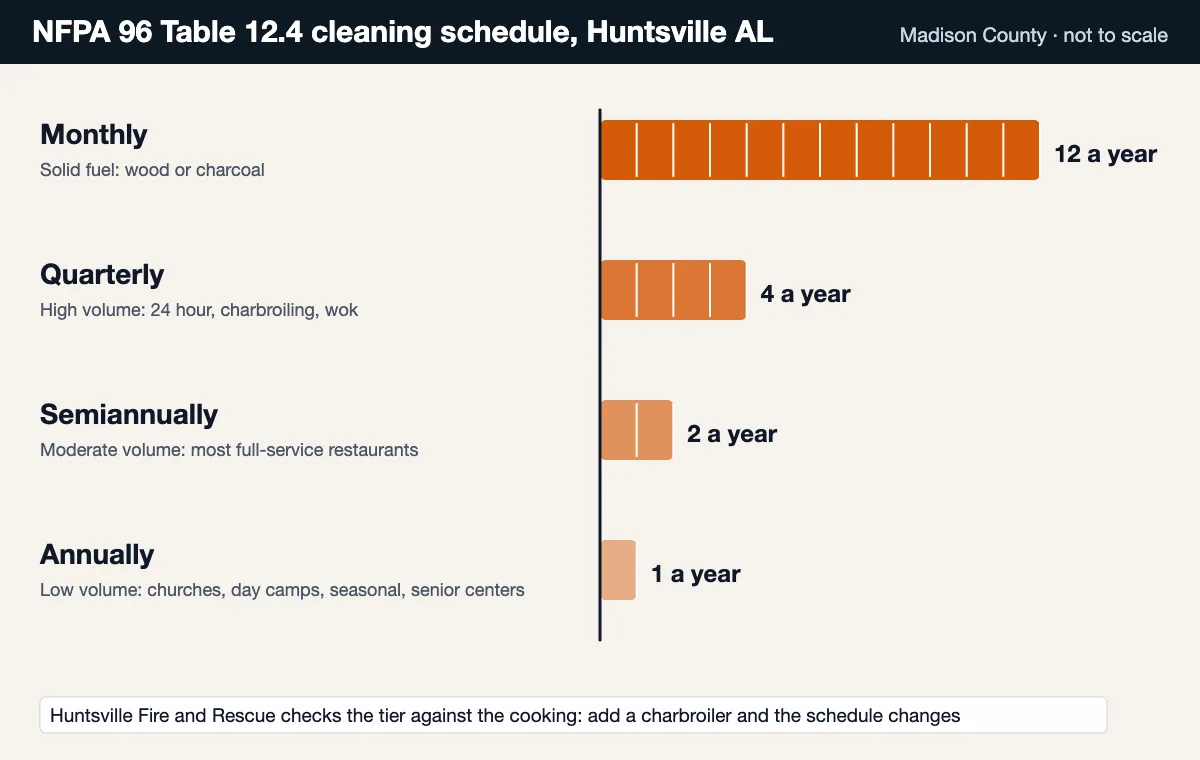
An annual service agreement covers the number of visits your kitchen is actually required to have under NFPA 96 Table 12.4, scheduled in advance, and is usually priced below one-off visits. Ask for both prices side by side. The yearly arithmetic is simple enough to do on the back of a ticket.
Using the 2026 national ranges, a full-service restaurant at $450 to $1,200 a visit on the semiannual schedule budgets $900 to $2,400 a year. A high-volume or 24 hour kitchen at $600 to $1,800 a visit on the quarterly schedule budgets $2,400 to $7,200. A solid fuel operation on the monthly schedule is the one where the agreement matters most, because twelve visits a year multiply any per-visit saving and because a missed month on a wood-fired line loads the system faster than any other kitchen type in the city.
The discount, though, is the smaller half of the benefit. The larger half is that a scheduled system never drifts into restoration territory, so you never pay a restoration catch-up price, and you never find yourself calling around Huntsville on a Thursday trying to get somebody on a roof before a compliance date lands on Monday. Emergency scheduling costs more everywhere, and it costs more in this trade because the work happens overnight.
One caveat worth stating plainly. An agreement should be written against your correct Table 12.4 tier, not the cheapest one. A contractor who signs a charbroiler-heavy kitchen up for annual service is selling a discount on a schedule that will not survive an inspection. If your cook line changes, the agreement should change with it.
What a Legitimate Quote Itemizes
Low quotes in this trade are almost always low because of what they leave out, and what they leave out is usually the duct and the fan. A hood face and a filter rack can be made to look clean in under an hour. The complete exhaust system NFPA 96 actually requires to be cleaned cannot. Before you accept any quote in Huntsville, check it against this list.
A phone quote given without a single question about your duct length, your roof access, your cooking equipment, or when the system was last serviced is not pricing your kitchen. It is pricing an average kitchen and hoping yours is one. Phone ranges are useful because operators need a budget figure, but the firm number should come after somebody has looked at the system.
Cost by Building Type Across Huntsville and Madison County
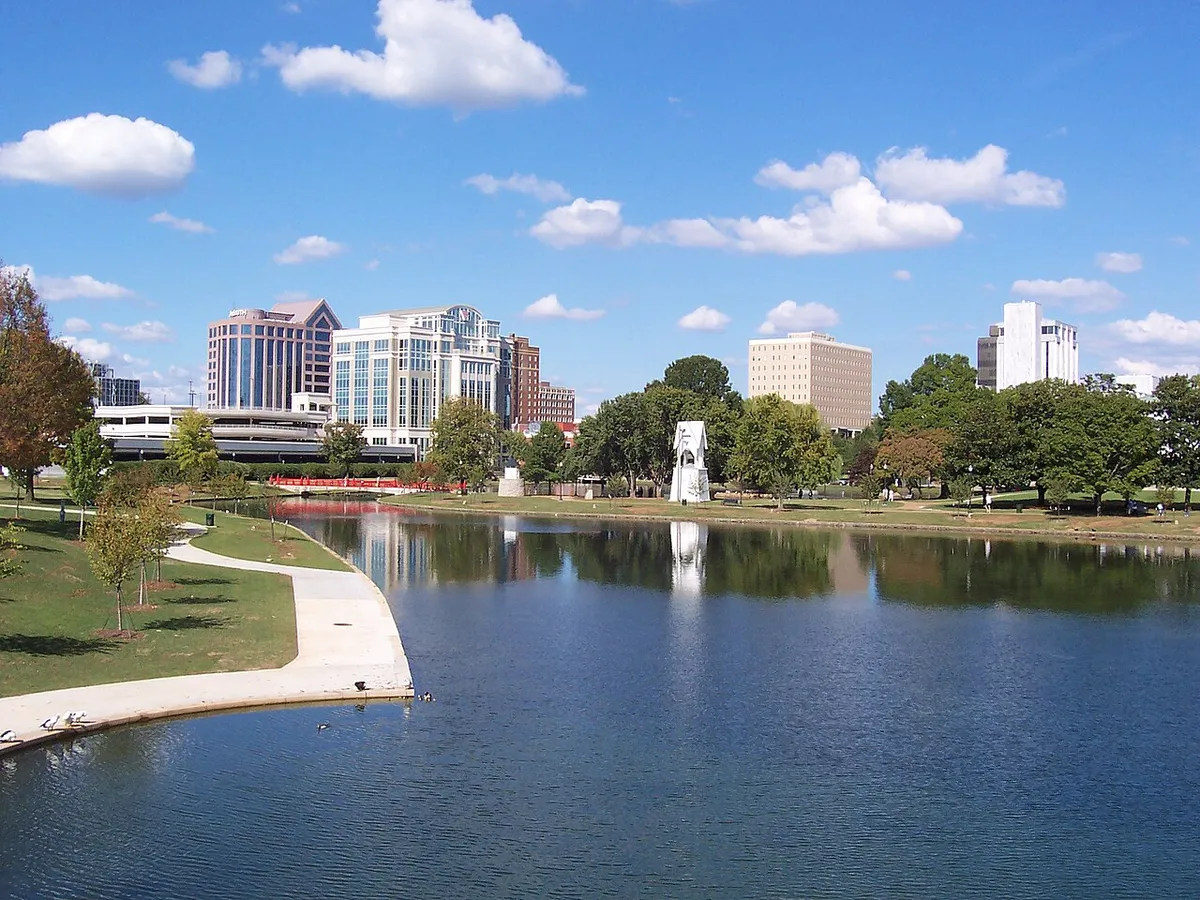
Two restaurants with identical menus and identical cooking volume can sit at opposite ends of the same price range because of the buildings they are in. Duct length, roof access, and whether access panels exist are the three variables that move a quote most, and all three are decided by the building rather than the kitchen.
Get an Accurate Quote for Your Kitchen
Every kitchen is different. Quotes given without seeing the system are estimates; on-site assessments give you an exact price based on duct length, system condition, and what's needed to bring your kitchen into compliance. We serve Huntsville, Madison, Athens, and surrounding areas in North Alabama.
Hood Cleaning Cost FAQ
How much does hood cleaning cost in Huntsville, AL?
No Huntsville company publishes a price list, so the best yardstick is the National Hood Cleaners Association's 2026 national ranges: $300 to $700 per visit for a small cafe, church kitchen or other light-use single hood; $450 to $1,200 for a standard full-service restaurant; $600 to $1,800 for a high-volume or multi-hood restaurant; and $1,000 to $3,500 or more for hotels, hospitals, commissaries and other complex systems. Filters, fan belts, hinge kits and access panels are usually quoted on top.
What is included in the hood cleaning price?
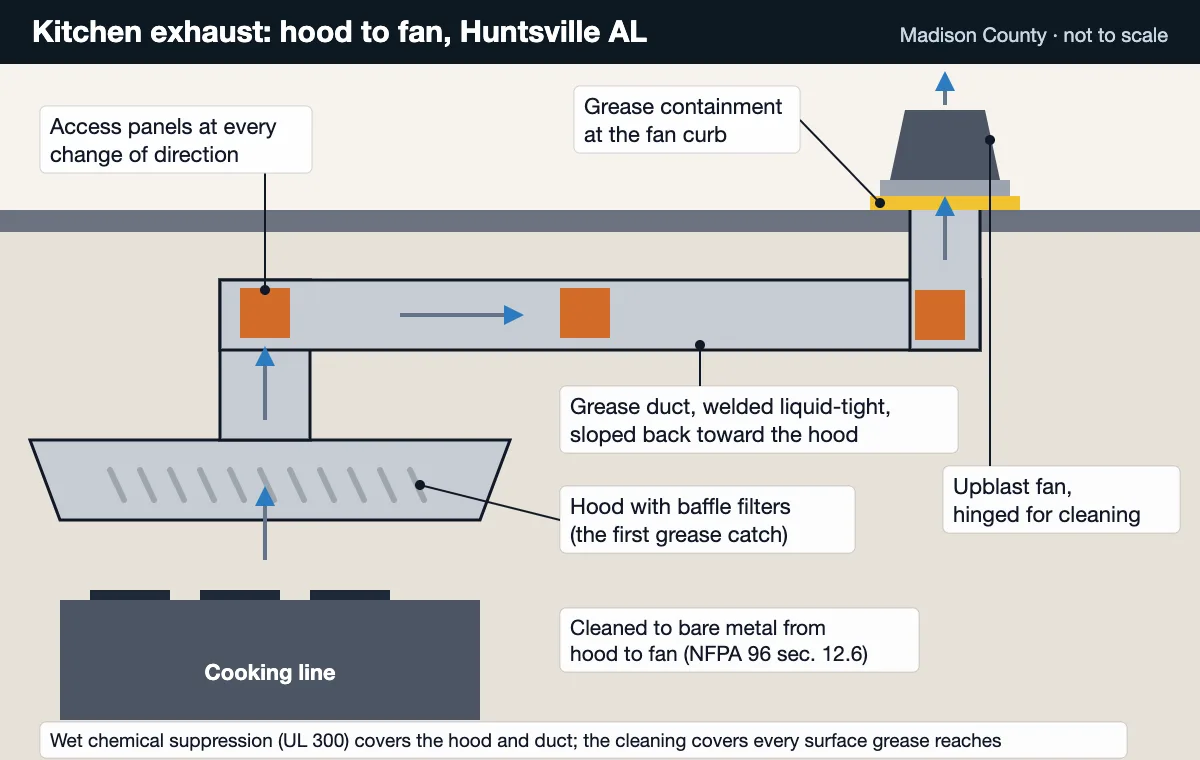
A complete hood cleaning service covers the hood canopy and grease drip trays, baffle filters, the grease duct from hood to rooftop, and the exhaust fan wheel, housing, and drain. It also includes the cleaning certificate affixed to the hood and a written service report with grease level documentation. Filter replacement and hinge kit installation are typically add-on items quoted separately.
Why does hood cleaning cost more for high-volume kitchens?
High-volume kitchens (24-hour operations, charbroilers, multiple fryers) accumulate significantly more grease between service visits. Heavier grease deposits require more chemical degreasers, longer cleaning time, and sometimes additional passes. Additionally, these kitchens tend to have longer duct systems or multiple exhaust systems that require individual cleaning.
Does annual hood cleaning cost less per year than quarterly cleaning?
Not necessarily. An annual cleaning on a system with heavy grease buildup takes significantly longer than a quarterly service on a well-maintained system. The per-visit cost for an overdue annual clean is typically much higher than a routine quarterly visit. Quarterly cleaning also prevents grease from baking onto surfaces over time, which reduces total cleaning time and cost per clean.
Why is my first hood cleaning quoted higher than the ongoing price?
Because the first visit on a neglected system is a restoration clean, not a maintenance clean. NFPA 96 Section 12.6.2 requires surfaces to be cleaned to bare metal, and grease that has been baking on a duct wall for two years does not come off in the same pass as grease from six months ago. Expect a restoration clean on a system far past its interval to be quoted well above the ongoing maintenance price, and ask for the difference to be explained line by line. Once the system is at bare metal, subsequent visits on schedule settle into the normal range for your kitchen type.
How much does an annual service agreement save in Huntsville?
Recurring service on a fixed schedule is usually priced lower per visit than one-off calls, because a system that never loads up heavily is faster to clean; ask for the agreement price and the per-visit price side by side. The yearly budget is the per-visit price times the Table 12.4 visits: a full-service restaurant in the 2026 national $450 to $1,200 band on a semiannual schedule budgets $900 to $2,400 a year, and a high-volume kitchen in the $600 to $1,800 band on a quarterly schedule $2,400 to $7,200. The larger saving is indirect: scheduled visits mean the system never falls into restoration territory, and you never pay emergency rates to get somebody on a roof the week an inspector gives you a compliance date.
Does my location in Huntsville affect the price?
Building type affects it more than distance. Older Downtown and Five Points buildings frequently have long horizontal duct runs, tight roof access, and no access panels, all of which add time. Newer build-outs around Providence, MidCity, and Town Madison are usually shorter runs with panels already in place. Distance only becomes a factor for the outer county, where a single kitchen in Meridianville, Hazel Green, or Toney carries a trip charge unless it can be scheduled alongside other work in the same area.
What should a hood cleaning quote itemize?
It should name every component included, which means hood and plenum, baffle filters, grease trough and drip containers, the full duct run, the exhaust fan wheel and housing, and the rooftop area around the fan base. It should list add-ons separately, each with its own price: replacement filters, hinge kits, access panels, rooftop containment and rooftop grease cleanup. Parts give a floor to check against: stainless baffle filters list from about $28.49 each at HoodFilters.com and a standard hinge kit about $92 at HoodMart, before labor. And it should state that a cleaning certificate and written service report are included. A single lump number with no component list is not a quote, it is a guess.
Is a $99 hood cleaning offer real?
It buys a wipe-down of the hood face and the filters, and it leaves the duct and the fan untouched. NFPA 96 requires the complete exhaust system to be cleaned, and a crew that never opened an access panel or went on the roof has not done that. The certificate you get from that visit says the system was cleaned when it was not, which is worse than having no certificate at all, because it is the document you will hand an insurance adjuster after a grease fire. For scale, the 2026 national range for even a light-use single hood is $300 to $700 a visit (National Hood Cleaners Association), so a price far below that is buying something other than a full-system clean.