Rooftop Grease Containment in Huntsville, AL
Grease containment system installation, service, and rooftop cleanup for commercial kitchens in Huntsville and Madison County. Prevents roof damage, fire risk, and code violations from accumulated grease around exhaust fans.
Rooftop Grease Containment Services
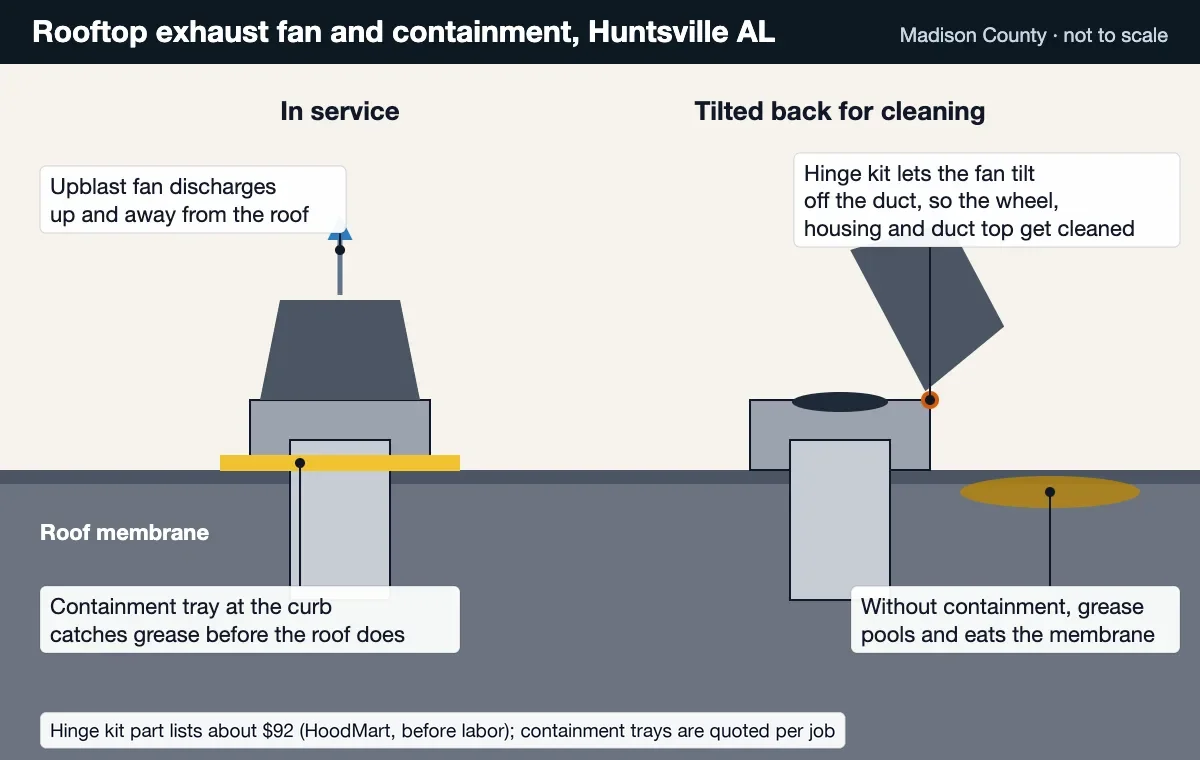
Every Type I exhaust system in Huntsville ends at a rooftop fan, and every rooftop fan sheds grease. The only question is whether that grease lands in a container you empty on a schedule or on a roof membrane that belongs to your landlord. Containment belongs at fan curbs across Huntsville and Madison County, from single-tenant buildings along Jordan Lane and University Drive to the shared roof decks over multi-kitchen food campuses Downtown.
Containment System Installation
Grease containment trays or bag systems should be sized and installed to fit your rooftop exhaust fan configuration. Systems are secured to prevent wind displacement and designed for easy servicing.
Containment System Servicing
At each hood cleaning service, the containment system should be emptied and cleaned. Overflow or saturated systems are replaced. Service should be documented on your cleaning certificate.
Rooftop Grease Cleanup
For rooftops with existing grease accumulation, the fan base area and surrounding roof surface get degreased as part of initial installation or as a standalone cleanup service.
Compliance Inspection
An assessment checks whether your current rooftop configuration meets NFPA 96 and local code requirements and recommends upgrades if needed.
NFPA 96 Section 8.3.1: What the Code Requires at a Rooftop Termination
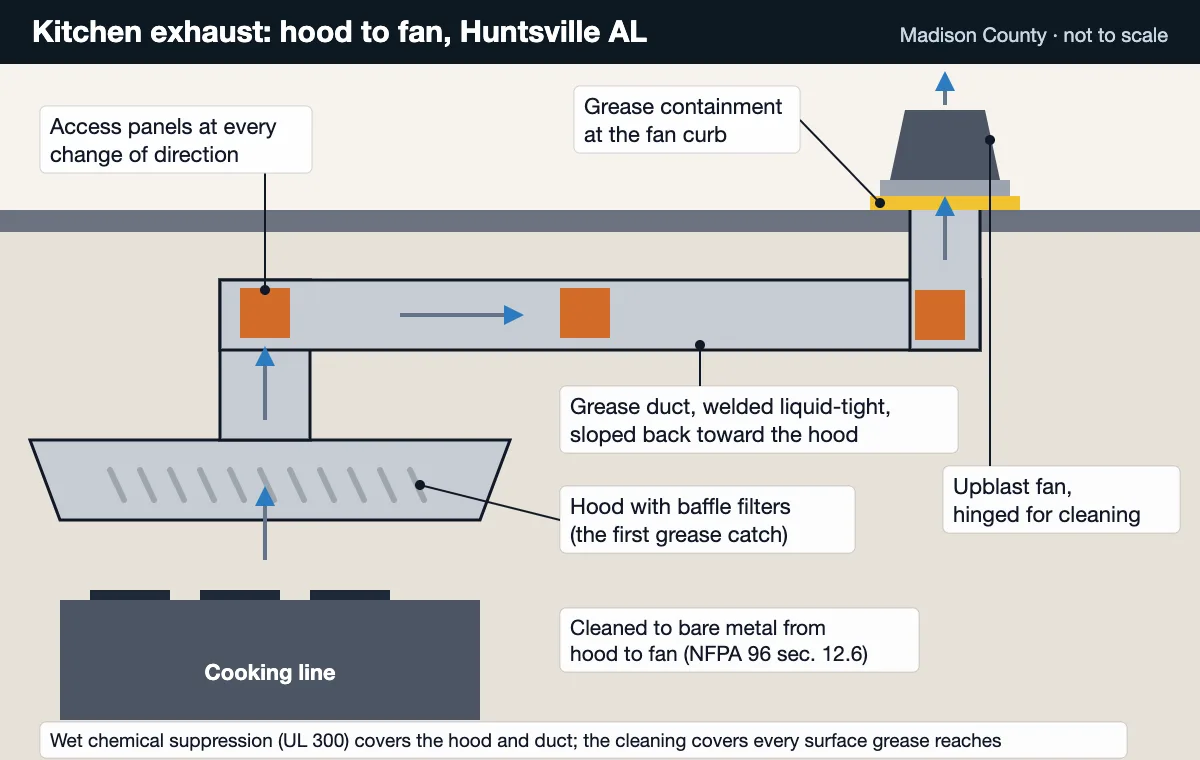
NFPA 96 does not treat the roof as the end of the system. Chapter 8 covers air movement, and Section 8.3.1 spells out what a rooftop termination has to be arranged with before it complies. Most operators have never read it, which is why the same three findings keep turning up on Madison County roofs. Alabama gets to NFPA 96 through two doors: the Alabama State Fire Marshal enforces NFPA 101, whose Section 9.2.3 sends commercial cooking equipment straight to NFPA 96, and the City of Huntsville enforces the International Fire Code, whose Section 609 does the same.
Section 8.3.1 requires a minimum of 10 feet of horizontal clearance between the exhaust outlet and adjacent buildings, property lines, and air intakes, and a minimum of 5 feet to any combustible structure. On the tight Downtown blocks around Clinton Row and Washington Street, where kitchens sit shoulder to shoulder in buildings that predate the standard by decades, this is the clearance that most often cannot be met without a listed high-velocity termination that discharges vertically.
The same section requires the outlet to discharge at least 40 inches above the roof surface. A short stack puts grease-laden air right back down onto the membrane it just left, and that is exactly how a fan curb ends up wearing a three foot black halo. When a fan sits low on its curb, the halo usually gives it away before anyone gets close enough to measure.
Then comes the containment language. Section 8.3.1 requires that grease be able to drain out of any traps or low points formed in the fan or duct near the termination into a collection container, and that the container be noncombustible, closed, rainproof, structurally sound, and incapable of sustaining combustion. The code caps that container at 1 gallon, the same ceiling NFPA 96 Chapter 6 puts on the drip container under your hood filters. Operators who swap in a 5 gallon bucket to stretch the service interval have traded a code-compliant setup for a violation and a fuel supply.
Two more clauses matter in the field. The collection device has to be applied in a way that does not inhibit fan performance, so a bag crammed under an up-blast discharge is a finding rather than a fix. And every grease collection device must be secured in place. On a Huntsville rooftop in March that is not paperwork. Straight line winds through the Tennessee Valley will walk an unsecured tray across a roof deck and over a parapet, and everything in it goes with it.
What Rooftop Grease Does to a Huntsville Roof
Containment is cheap. A roof section is not. Huntsville's climate does most of the damage work on its own: roughly 55 inches of rain a year, dark membrane surface temperatures well past 150 degrees through a Tennessee Valley summer, and a winter that cycles above and below freezing a few dozen times. A membrane that grease has been softening all summer is the same spot that splits in January. Below is how the four most common roof systems around Huntsville actually fail.
EPDM Single-Ply
The black rubber membrane on a large share of Huntsville strip retail built from the 1990s onward. EPDM is specifically vulnerable to animal and vegetable fats. Grease swells the rubber, softens it, and pulls plasticizers out, which shows up first as a dark glossy halo around the fan curb and later as a soft spot that fails under foot traffic.
TPO Single-Ply
More grease resistant than EPDM and common on newer builds around Madison and Providence. It still stains, and prolonged saturation degrades the seam welds. TPO seams are heat welded, so a weakened seam at a fan curb is where water gets in first.
Modified Bitumen and Built-Up Roofing
Asphalt based systems found on older Downtown and Five Points buildings. Grease dissolves asphalt. On a built-up roof with a gravel surface, the grease also binds the gravel into a mat that traps water against the membrane.
Metal Deck and Curb Flashing
Grease that gets past the membrane at the curb flashing sits against the metal deck where nobody can see it. This is the failure mode that turns a small containment job into a roof section replacement, because the first symptom is usually a ceiling stain in the dining room.
Containment Systems Used in Huntsville and Madison County

There is no single correct containment device. The right one depends on what you cook, how much grease the fan actually produces, what the curb looks like, and whether the roof already has a problem to clean up. A wood-fired line in Providence and a low-volume bakery kitchen in Madison both need containment, but giving them the same tray means one gets serviced too often and the other overflows in six weeks.
Absorbent Tray Systems
A stainless or aluminized tray that sits at the fan curb with a replaceable absorbent pillow inside. This is the workhorse on most Huntsville strip retail and single-tenant buildings. It handles the normal slow weep from an up-blast fan, it is easy to service from the roof hatch, and the media carries away liquid grease rather than letting it pool on the curb flashing.
Grease Box and Bag Units
A closed container mounted to the fan or curb, plumbed to the fan drain, with a disposable liner. Better suited to higher output lines where a pillow saturates too fast. NFPA 96 caps the container at 1 gallon, so a bigger box is not the answer to a fan that produces more grease. A shorter service interval is.
Curb-Mounted Catch Basins
A perimeter basin that captures runoff from the whole curb rather than just the drain point. These suit spots where grease has already been migrating for years and the membrane around the curb is stained out past the flashing, common on older Downtown and Five Points buildings where the fan predates the current tenant by two or three restaurants.
High-Capacity Solid Fuel Containment
Wood and charcoal operations throw both grease and particulate. A standard pillow blinds off quickly under that load. These kitchens get a larger-surface tray with a coarser media and a monthly service interval that matches their NFPA 96 Table 12.4 monthly cleaning schedule.
Retrofit Fan Drain Kits
Many older up-blast fans around Meridianville, Hazel Green, and the county pockets outside the Huntsville city limits were set on a curb with no drain fitting at all. A retrofit kit taps the low point of the housing, fits a drain nipple, and routes it to a secured container so the fan drains to a place you can empty instead of over the lip of the curb.
Secured Mounting Hardware
NFPA 96 requires every grease collection device to be secured in place. Trays and boxes should be anchored to the curb rather than set loose on the membrane. Straight line winds through the Tennessee Valley will move an unsecured tray across a roof deck, and a tray that has traveled has already dumped its contents somewhere else.
Rooftop Containment Pricing and Service Cadence in Huntsville (2026)
Containment is quoted per fan, sized to the fan curb footprint and to whether the fan already has a usable drain; no Huntsville company publishes a price, and the National Hood Cleaners Association lists containment among the add-ons usually priced outside the cleaning. A standalone rooftop grease cleanup, degreasing the fan base and the surrounding membrane, is quoted by how far the grease has spread past the flashing. Both assume roof access through a hatch or a fixed ladder. Buildings that require a lift, which includes several of the taller Downtown and Research Park properties, are quoted separately.
Service cadence follows your NFPA 96 Table 12.4 cleaning schedule rather than a separate calendar. Solid fuel operations on monthly cleaning get monthly containment service. High-volume and 24 hour kitchens on quarterly cleaning get quarterly. Most full-service restaurants in Huntsville run semiannual, which means the containment is emptied and the media replaced twice a year at the same visit as the hood, duct, and fan. Bundling it into the scheduled visit is what keeps the cost down. A dedicated rooftop trip carries its own truck charge.
The cadence only works if nothing changes on the cook line. Adding a charbroiler, extending hours into late night service, or switching a fryer program from once-a-week to daily will all push the containment past its interval even though the cleaning schedule on paper stayed the same. Tell your cleaning contractor when the menu changes so the interval gets reset, rather than letting you find out from a roof stain.
Check the Roof Before the Next Scheduled Visit If You See Any of These
Rooftop Grease Containment in Huntsville, AL: Frequently Asked Questions
What is a rooftop grease containment system?
A grease containment system is a tray, bag, or catch basin installed at the base of the rooftop exhaust fan to collect grease that is expelled or drips from the fan during normal operation. Without one, grease accumulates on the roof surface, staining and degrading roofing materials and creating a fire hazard around the fan base.
Is rooftop grease containment required by code?
NFPA 96 and most local fire codes require that grease-laden vapors and expelled grease not be allowed to accumulate on rooftop surfaces. While specific containment system requirements vary by jurisdiction, Huntsville Fire & Rescue expects rooftop areas around exhaust fans to be free of accumulated grease as part of a compliant kitchen exhaust system.
How often does the containment system need to be serviced?
The containment system should be emptied and cleaned at the same time as the exhaust fan, which is part of your regular NFPA 96 cleaning schedule. For high-volume kitchens, this may be quarterly. For moderate-volume restaurants, semi-annually.
What happens if grease pools on the roof around my exhaust fan?
Pooled grease on rooftop surfaces damages roofing membranes and accelerates deterioration. It also creates a fire hazard around the fan base and, in dry weather, can be ignited by sparks from the exhaust. Some commercial leases and property insurance policies require grease containment as a condition of coverage.
Will rooftop grease void my roof warranty in Huntsville?
It can. Single-ply membrane warranties from the major manufacturers generally require the building owner to keep the membrane free of grease, oils, and other contaminants, and they exclude damage caused by them. If your landlord holds a 15 or 20 year warranty on a TPO or EPDM roof over your leased space, grease staining around your fan curb is one of the first things an inspector will point to when a claim is denied. Installing containment is far cheaper than arguing about a roof section.
Does grease running off my roof create a stormwater problem?
Yes. Huntsville averages roughly 55 inches of rain a year, which is enough to carry rooftop grease to the scuppers and drains and then into the municipal storm system. Huntsville operates a municipal separate storm sewer system under a permit issued by the Alabama Department of Environmental Management, and non-stormwater discharges such as grease are prohibited. A visible grease trail from a roof drain to a parking lot inlet is an enforceable illicit discharge, separate from any fire code issue.
How much does a rooftop grease containment system cost in Huntsville?
No Huntsville company publishes a price, so containment is quoted per fan, sized to the fan curb footprint. A standalone rooftop grease cleanup, degreasing the fan base and the surrounding membrane, is quoted by how far the grease has spread. The National Hood Cleaners Association lists containment among the add-ons usually priced outside the cleaning itself. Absorbent media replacement is included when the containment is serviced alongside your scheduled hood cleaning rather than billed as a separate trip.
What kind of containment works best on a food hall roof with several tenant fans?
Individual tray systems at each fan curb, not a shared perimeter approach. Downtown Huntsville has several multi-tenant food campuses where a dozen kitchens vent onto one roof deck. When grease from one tenant migrates across the membrane, nobody can prove whose fan it came from, and the whole building ends up in a dispute with the landlord. Per-fan containment with the tenant name recorded on the service report keeps responsibility attributable.
How often does the absorbent media inside the containment tray need changing?
On a semiannual kitchen it usually lasts the full six months between cleanings. On a quarterly charbroiler line in Jones Valley or a late-night fryer operation off University Drive, the pillow is normally saturated well before the next scheduled visit, so a midpoint media swap makes sense. Saturated media is worse than no media at all, because it holds a standing pool of liquid grease directly on the curb flashing instead of wicking it away. Media replacement is usually cheapest alongside a scheduled service and is typically quoted separately if it needs its own rooftop trip.
My exhaust fan has no drain fitting. Can containment still be installed?
Yes. NFPA 96 Section 8.3.1 expects grease to be able to drain out of traps and low points near the termination into a collection container, and plenty of older up-blast fans on Five Points and Meridianville buildings were installed before anyone enforced that. A retrofit drain nipple can be fitted into the low point of the fan housing and routed into a secured 1 gallon container at the curb. It is a short job on a service visit and it converts a fan that simply overflows onto the roof into one that drains to a point you can empty.
Who is responsible for rooftop grease, the tenant or the landlord?
Read your lease, but in nearly every Huntsville commercial food service lease, the tenant owns the exhaust system from the hood through the rooftop fan and is responsible for grease generated by their operation. The landlord owns the roof membrane. That split is exactly why containment matters: the party that causes the damage is not the party that holds the roof warranty, and the repair bill lands on the tenant through the indemnity clause. A dated service report showing containment installed and emptied on schedule is the cheapest evidence you can hold.